New York Clearing House (New York, NY)

Episode Information

Episode UID
1020071376
Episode Type
Suspension โ†’ Reopening
Bank Type
trust
Bank ID
102007 routing
Routing Number
1-0200
Start Date
August 1, 1914*
Location
New York, New York (40.714, -74.006)

Metadata

Model
gpt-5-mini (chosen from majority vote of a three-model LLM ensemble)
Short Digest
dc0c463a8fdcf6d6

Response Measures

None

Description

Suspension driven by European war/currency shortage; reopening is not explicitly described but the clearing house did not permanently close.

Events (1)

1. August 1, 1914* Suspension
Cause
Macro News
Cause Details
European war produced a currency shortage; clearing house closed doors, suspended business and issued clearing house certificates to meet the situation
Newspaper Excerpt
the clearing house board of trade closed doors and suspended business
Source
newspapers

Newspaper Articles (2)

Article from The Arvada Enterprise, August 6, 1914

Click image to open full size in new tab

Article Text

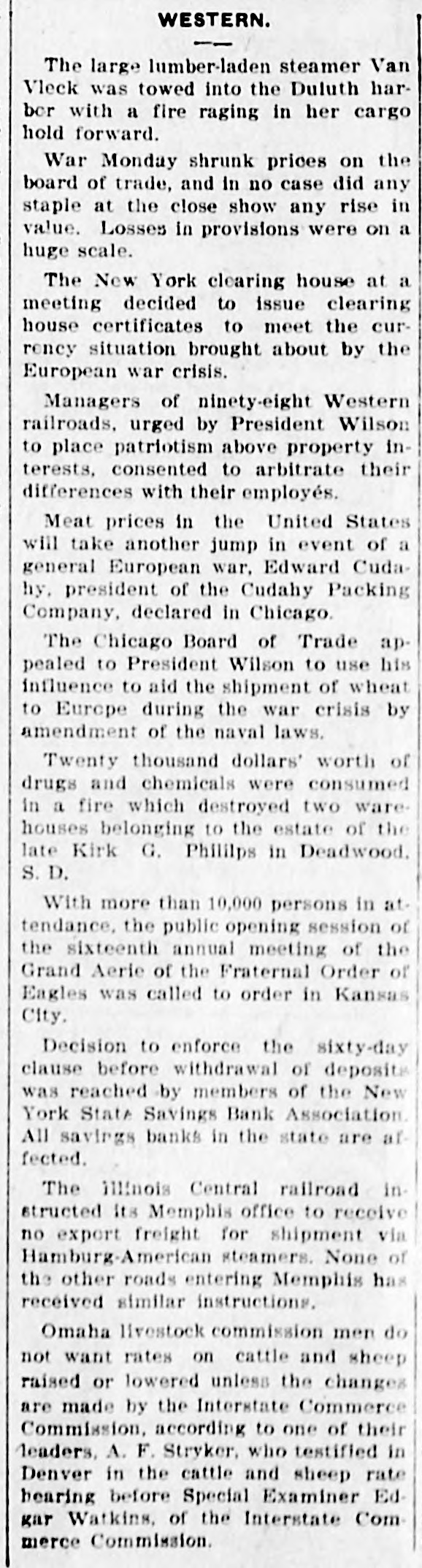
WESTERN. The large lumber-laden steamer Van Vleck was towed into the Duluth harbor with a fire raging in her cargo hold forward. War Monday shrunk prices on the board of trade, and in no case did any staple at the close show any rise in value. Losses in provisions were on a huge scale. The New York clearing house at a meeting decided to issue clearing house certificates to meet the currency situation brought about by the European war crisis. Managers of ninety-eight Western railroads, urged by President Wilson to place patriotism above property interests, consented to arbitrate their differences with their employรฉs. Meat prices in the United States will take another jump in event of a general European war, Edward Cudahy, president of the Cudahy Packing Company, declared in Chicago. The Chicago Board of Trade appealed to President Wilson to use his influence to aid the shipment of wheat to Europe during the war crisis by amendment of the naval laws. Twenty thousand dollars' worth of drugs and chemicals were consumed in a fire which destroyed two warehouses belonging to the estate of the late Kirk G. Philips in Deadwood S. D. With more than 10,000 persons in attendance, the public opening session of the sixteenth annual meeting of the Grand Aerie of the Fraternal Order of Eagles was called to order in Kansas City. Decision to enforce the sixty-day clause before withdrawal of deposits was reached by members of the New York State Savings Bank Association All savings banks in the state are at fected. The illinois Central railroad in structed its Memphis office to receive no export freight for shipment via Hamburg-American steamers. None of the other roads entering Memphis has received similar instructions. Omaha livestock commission men do not want rates on cattle and sheep raised or lowered unless the changes are made by the Interstate Commerce Commission, according to one of their leaders. A. F. Stryker, who testified in Denver in the cattle and sheep rate bearing before Special Examiner Edgar Watkins, of the Interstate Com merce Commission

Article from The Ward County Independent, October 1, 1914

Click image to open full size in new tab

Article Text

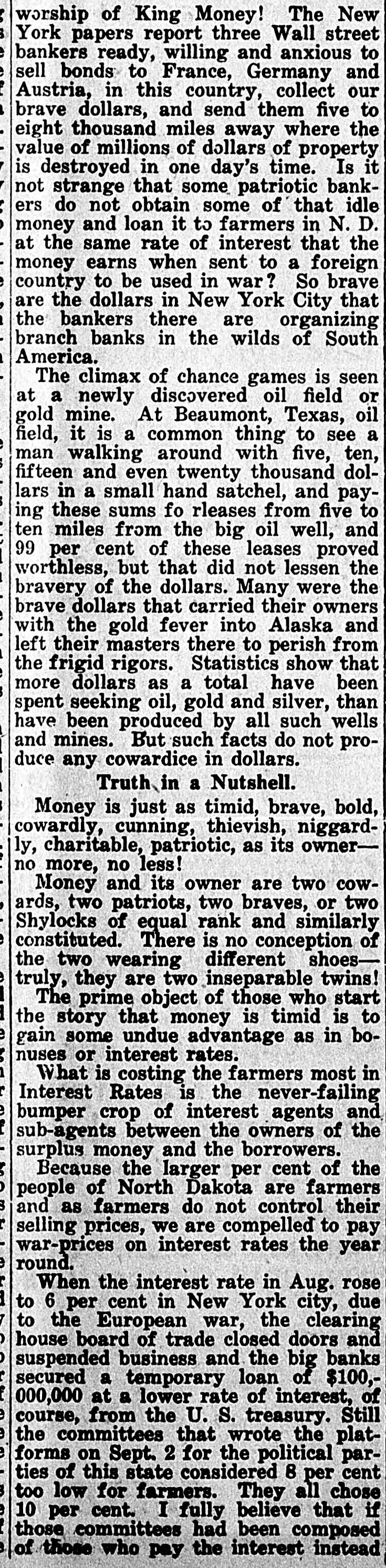
# Worship of King Money! The New York papers report three Wall street bankers ready, willing and anxious to sell bonds to France, Germany and Austria, in this country, collect our brave dollars, and send them five to eight thousand miles away where the value of millions of dollars of property is destroyed in one day's time. Is it not strange that some patriotic bankers do not obtain some of that idle money and loan it to farmers in N. D. at the same rate of interest that the money earns when sent to a foreign country to be used in war? So brave are the dollars in New York City that the bankers there are organizing branch banks in the wilds of South America. The climax of chance games is seen at a newly discovered oil field or gold mine. At Beaumont, Texas, oil field, it is a common thing to see a man walking around with five, ten, fifteen and even twenty thousand dollars in a small hand satchel, and paying these sums fo rleases from five to ten miles from the big oil well, and 99 per cent of these leases proved worthless, but that did not lessen the bravery of the dollars. Many were the brave dollars that carried their owners with the gold fever into Alaska and left their masters there to perish from the frigid rigors. Statistics show that more dollars as a total have been spent seeking oil, gold and silver, than have been produced by all such wells and mines. But such facts do not produce any cowardice in dollars. # Truth in a Nutshell. Money is just as timid, brave, bold, cowardly, cunning, thievish, niggardly, charitable, patriotic, as its owner-no more, no less! Money and its owner are two cowards, two patriots, two braves, or two Shylocks of equal rank and similarly constituted. There is no conception of the two wearing different shoes-truly, they are two inseparable twins! The prime object of those who start the story that money is timid is to gain some undue advantage as in bonuses or interest rates. What is costing the farmers most in Interest Rates is the never-failing bumper crop of interest agents and sub-agents between the owners of the surplus money and the borrowers. Because the larger per cent of the people of North Dakota are farmers and as farmers do not control their selling prices, we are compelled to pay war-prices on interest rates the year round. When the interest rate in Aug. rose to 6 per cent in New York city, due to the European war, the clearing house board of trade closed doors and suspended business and the big banks secured a temporary loan of $100,000,000 at a lower rate of interest, of course, from the U. S. treasury. Still the committees that wrote the platforms on Sept. 2 for the political parties of this state considered 8 per cent too low for farmers. They all chose 10 per cent. I fully believe that if those committees had been composed of those who pay the interest instead