Bowery Savings Bank (New York, NY)

Episode Information

Episode UID
1017571295
Episode Type
Suspension β†’ Reopening
Bank Type
savings
Bank ID
101757 routing
Routing Number
1-0175
Start Date
November 1, 1907*
Location
New York, New York (40.714, -74.006)

Metadata

Model
gpt-5-mini (chosen from majority vote of a three-model LLM ensemble)
Short Digest
b66fc66b45420e36

Response Measures

None

Description

Partial suspension via thirty- and sixty-day clauses during the 1907 panic; later normal withdrawals resumed.

Events (2)

1. November 1, 1907* Suspension
Cause
Macro News
Cause Details
Invoked thirty- and sixty-day notice clauses during the November 1907 financial scare (Panic of 1907) to limit withdrawals.
Newspaper Excerpt
The operation of the thirty and sixty day clauses has been most encouraging, and depositors who gave notice of withdrawal in the scare times two weeks ago are coming into the savings banks every day and cancelling these notices.
Source
newspapers
2. December 26, 1907 Reopening
Newspaper Excerpt
The Bowery Savings Bank's increase in deposits Tuesday was $30,000; to-day it was approximately $50,000. ... Few Savings Bank Depositors Take Advantage of Their Privilege. Deposits Exceed Withdrawals in New York Institutions and Bankers Are Elated. New York, Dec. 26.-Much confidence was restored in savings bank circles today when but few persons appeared at the expiration of the sixty-day clause, which the banks had taken advantage of to fortify themselves. The Bowery Savings Bank's increase in deposits Tuesday was $30,000; to-day it was approximately $50,000.
Source
newspapers

Newspaper Articles (2)

Article from New-York Tribune, November 21, 1907

Click image to open full size in new tab

Article Text

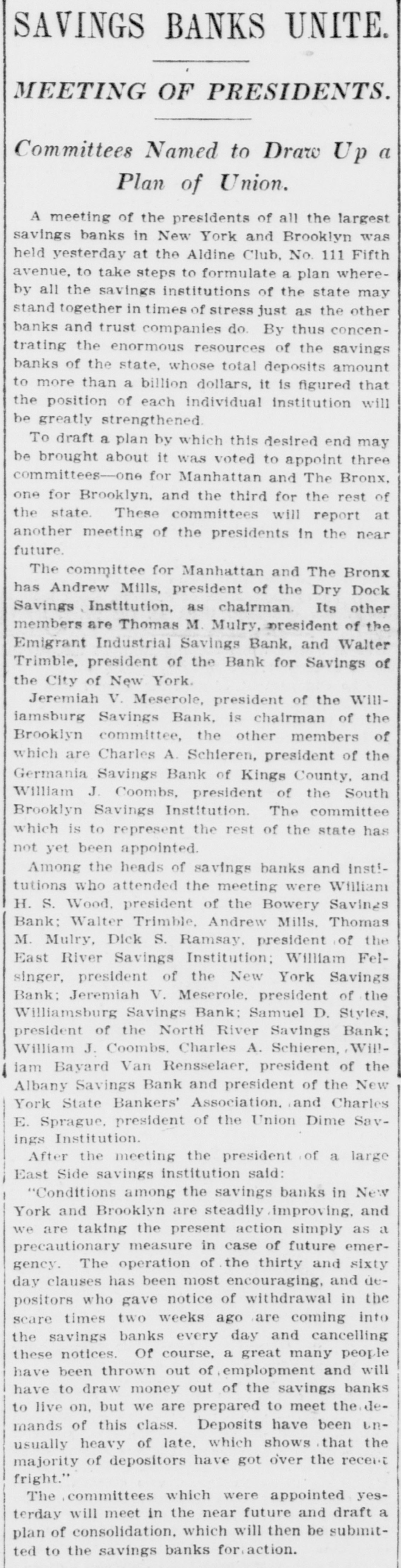
SAVINGS BANKS UNITE. MEETING OF PRESIDENTS. Committees Named to Draw Up a Plan of Union. A meeting of the presidents of all the largest savings banks in New York and Brooklyn was held yesterday at the Aldine Club, No. 111 Fifth avenue, to take steps to formulate a plan whereby all the savings institutions of the state may stand together in times of stress just as the other banks and trust companies do. By thus concentrating the enormous resources of the savings banks of the state, whose total deposits amount to more than a billion dollars, it is figured that the position of each individual institution will be greatly strengthened To draft a plan by which this desired end may be brought about it was voted to appoint three committees-one for Manhattan and The Bronx. one for Brooklyn, and the third for the rest of the state. These committees will report at another meeting of the presidents in the near future. The committee for Manhattan and The Bronx has Andrew Mills, president of the Dry Dock Savings Institution, as chairman. Its other members are Thomas M. Mulry, president of the Emigrant Industrial Savings Bank, and Walter Trimble, president of the Bank for Savings of the City of New York. Jeremiah V. Meserole, president of the Williamsburg Savings Bank, is chairman of the Brooklyn committee, the other members of which are Charles A. Schleren, president of the Germania Savings Bank of Kings County, and William J. Coombs, president of the South Brooklyn Savings Institution. The committee which is to represent the rest of the state has not yet been appointed. Among the heads of savings banks and inst!tutions who attended the meeting were William H. S. Wood. president of the Bowery Savings Bank: Walter Trimble, Andrew Mills, Thomas M. Mulry, Dick S. Ramsay, president of the East River Savings Institution: William Felsinger, president of the New York Savings Bank: Jeremiah V. Meserole, president of the Williamsburg Savings Bank: Samuel D. Styles, president of the North River Savings Bank: William J. Coombs. Charles A. Schieren, William Bayard Van Rensselaer, president of the Albany Savings Bank and president of the New York State Bankers' Association, and Charles E. Sprague, president of the Union Dime Savings Institution. After the meeting the president of a large East Side savings institution said: "Conditions among the savings banks in New York and Brooklyn are steadlly improving. and we are taking the present action simply as a precautionary measure in case of future emergency. The operation of the thirty and sixty day clauses has been most encouraging, and depositors who gave notice of withdrawal in the scare times two weeks ago are coming into the savings banks every day and cancelling these notices. Of course, a great many people have been thrown out of emplopment and will have to draw money out of the savings banks to live on, but we are prepared to meet the demands of this class. Deposits have been inusually heavy of late. which shows that the majority of depositors have got over the recent fright." The committees which were appointed yesterday will meet in the near future and draft a plan of consolidation, which will then be submitted to the savings banks for action.

Article from The Washington Herald, December 27, 1907

Click image to open full size in new tab

Article Text

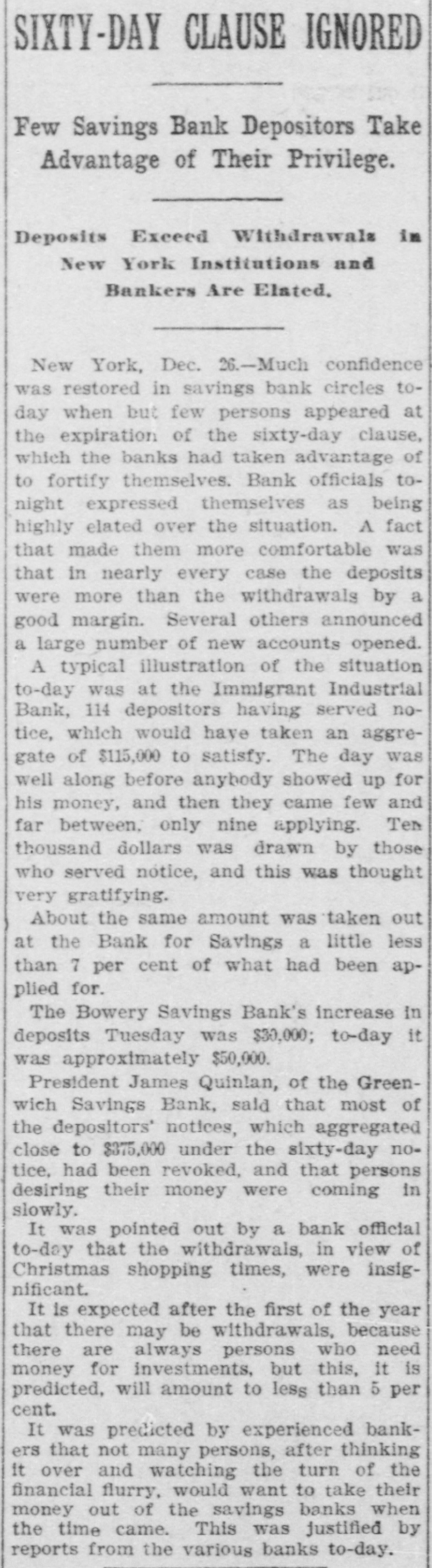
SIXTY-DAY CLAUSE IGNORED Few Savings Bank Depositors Take Advantage of Their Privilege. Deposits Exceed Withdrawals in New York Institutions and Bankers Are Elated. New York, Dec. 26.-Much confidence was restored in savings bank circles today when but few persons appeared at the expiration of the sixty-day clause, which the banks had taken advantage of to fortify themselves. Bank officials tonight expressed themselves as being highly elated over the situation. A fact that made them more comfortable was that in nearly every case the deposits were more than the withdrawals by a good margin. Several others announced a large number of new accounts opened. A typical illustration of the situation to-day was at the Immigrant Industrial Bank, 114 depositors having served notice, which would have taken an aggregate of $115,000 to satisfy. The day was well along before anybody showed up for his money, and then they came few and far between. only nine applying. Ten thousand dollars was drawn by those who served nΓ³tice, and this was thought very gratifying. About the same amount was taken out at the Bank for Savings a little less than 7 per cent of what had been applied for. The Bowery Savings Bank's increase in deposits Tuesday was $30,000; to-day it was approximately $50,000. President James Quinlan, of the Greenwich Savings Bank, said that most of the depositors' notices, which aggregated close to $375,000 under the sixty-day notice, had been revoked, and that persons desiring their money were coming in slowly. It was pointed out by a bank official to-day that the withdrawals, in view of Christmas shopping times, were insignificant. It is expected after the first of the year that there may be withdrawals, because there are always persons who need money for investments, but this, it is predicted, will amount to less than 5 per cent. It was predicted by experienced bankers that not many persons, after thinking it over and watching the turn of the financial flurry, would want to take their money out of the savings banks when the time came. This was justified by reports from the various banks to-day.