10146. Salmon & Salmon bank (Clinton, MO)

Bank Information

Episode Type
Suspension → Closure
Bank Type
state
Start Date
June 21, 1905
Location
Clinton, Missouri (38.371, -93.768)

Metadata

Model
gpt-5-mini
Short Digest
7c87ab9f

Response Measures

None

Description

The Salmon & Salmon bank closed its doors in June 1905 and was placed in receivership and federal bankruptcy; no contemporaneous run is described in the articles. The failure was driven by bank-specific adverse information (forged/spurious paper and a dishonest cashier). Dates in sources vary (some say June 1, 1905; several say June 21, 1905) — I use June 21, 1905 as the primary closure date because it is repeatedly reported. Later articles (1907) describe indictments and trials of the bank's principals.

Events (6)

1. June 21, 1905 Suspension
Cause
Bank Specific Adverse Info
Cause Details
Dishonest cashier (T. M. Casey) committed forgeries and misapplied funds; large amount of bills receivable alleged spurious; insolvency tied to cattle dealings of the Salmons and forged notes.
Newspaper Excerpt
which closed its doors on June 21, 1905, with liabilities of $1,000,000.
Source
newspapers
2. June 27, 1905 Receivership
Newspaper Excerpt
John B. Egger, of Appleton City, a banker, was appointed receiver of the Salmon institution yesterday. Dissatisfied depositors at once appealed to the United States court to have the concern placed in involuntary bankruptcy.
Source
newspapers
3. July 22, 1905 Other
Newspaper Excerpt
John B. Eggar, receiver of the Salmon & Salmon bank, filed his first statement with the circuit clerk to-day. The statement shows resources of a face value of $860,131.05 ... liabilities are given at $1,003,360.69 ... money borrowed from Kansas City State Bank, $158,000; money borrowed from Commonwealth Trust company, St. Louis, $53,395.95.
Source
newspapers
4. September 1, 1905* Other
Newspaper Excerpt
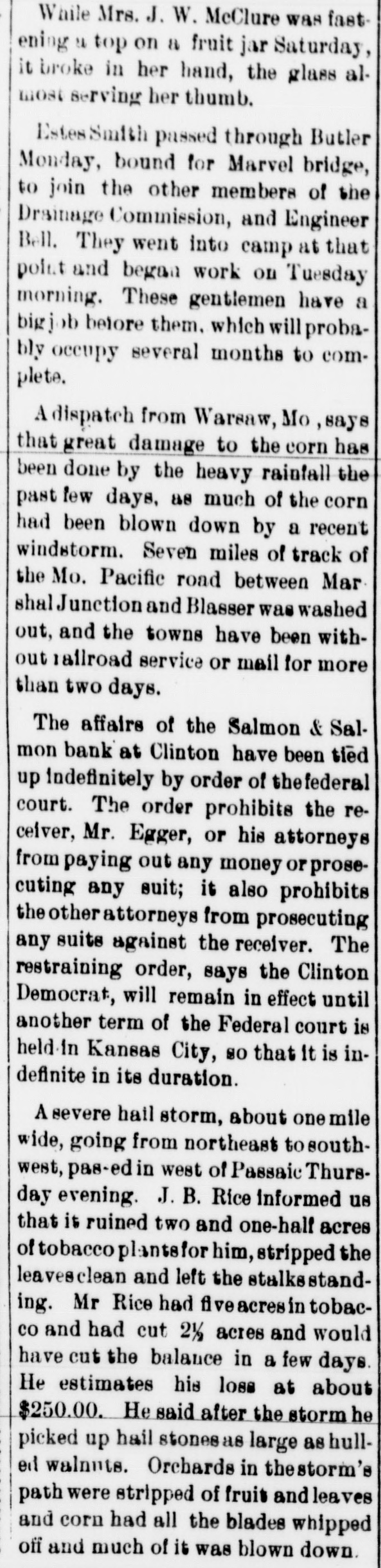
The affairs of the Salmon & Salmon bank at Clinton have been tied up indefinitely by order of the federal court. The order prohibits the receiver ... from paying out any money ... will remain in effect until another term of the Federal court is held in Kansas City, so that it is indefinite in its duration.
Source
newspapers
5. February 5, 1906 Other
Newspaper Excerpt
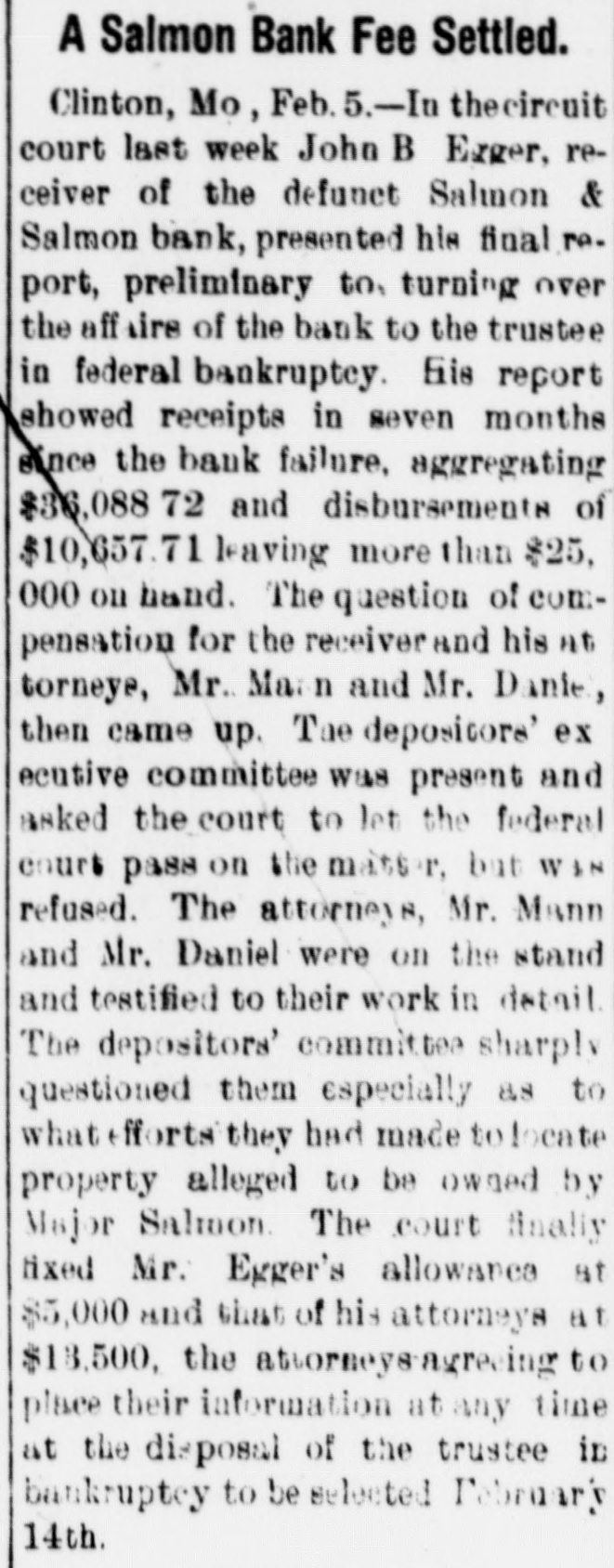
John B Erger, receiver of the defunct Salmon & Salmon bank, presented his final report, preliminary to turning over the affairs of the bank to the trustee in federal bankruptcy ... receipts ... $36,088.72 ... disbursements ... $10,657.71 ... court fixed Mr. Egger's allowance at $5,000 and that of his attorneys at $18,500.
Source
newspapers
6. March 28, 1907 Other
Newspaper Excerpt
An effort is being made here today to secure a jury to try the case against Major Harvey W. Salmon; charged with grand larceny in connection with the failure of the Salmon & Salmon bank of Clinton.
Source
newspapers

Newspaper Articles (11)

Article from Evening Times-Republican, June 27, 1905

Click image to open full size in new tab

Article Text

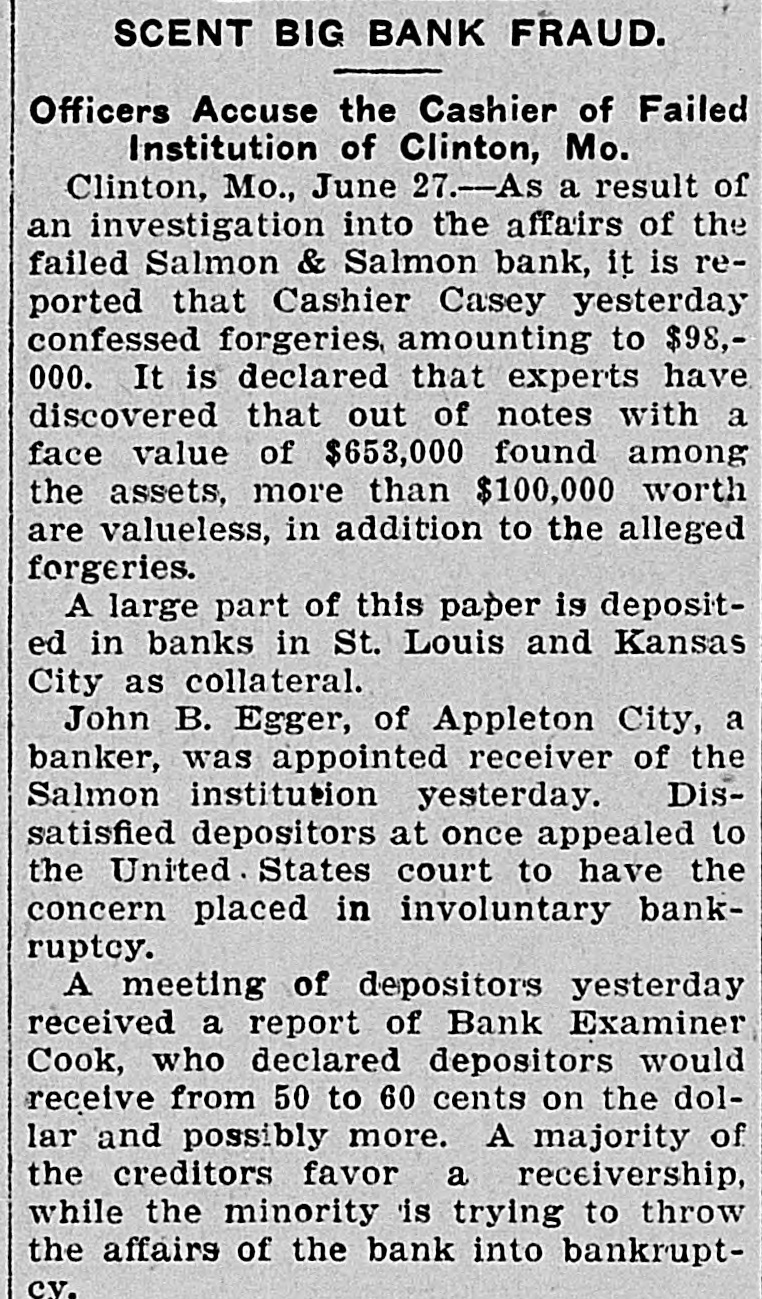
SCENT BIG BANK FRAUD. Officers Accuse the Cashier of Failed Institution of Clinton, Mo. Clinton, Mo., June 27.-As a result of an investigation into the affairs of the failed Salmon & Salmon bank, it is reported that Cashier Casey yesterday confessed forgeries, amounting to $98,000. It is declared that experts have discovered that out of notes with a face value of $653,000 found among the assets, more than $100,000 worth are valueless, in addition to the alleged forgeries. A large part of this paper is deposited in banks in St. Louis and Kansas City as collateral. John B. Egger, of Appleton City, a banker, was appointed receiver of the Salmon institution yesterday. Dissatisfied depositors at once appealed to the United. States court to have the concern placed in involuntary bankruptcy. A meeting of depositors yesterday received a report of Bank Examiner Cook, who declared depositors would receive from 50 to 60 cents on the dollar and possibly more. A majority of the creditors favor a receivership, while the minority is trying to throw the affairs of the bank into bankruptcv.
Article from The Butler Weekly Times, June 29, 1905

Click image to open full size in new tab

Article Text

Thomas M. Casey, cashier of the Salmon & Salmon bank, at Clinton, was arrested Sunday On a charge of forging the name of Wm. M. Stephens to notes aggregating $9,000. These notes with others were deposited with the Kansas City State bank to secure heavy loans. Much excitement was created by the Casey arrest. Judge Denton, who was on his way to Warsaw to hold court, wasreached at Sedalia and prevailed on to go to Clinton Monday, where he appointed John B. Egger, of Appleton City bank, receiver for the Salmon bank. No official statement has been given out by the examiner in charge, but it is said the condition is much worse than at first thought and there is talk that not over 20 per cent will be paid depositors' Salmon & Salmon bank had the confidence of not only the people of that county, but this section of the state and many Bates county citizens of the enstside will suffer. Many pathettie incidents are being told of people who lost their all, the savings of a dife time of hard work and frugality.


Article from Bisbee Daily Review, July 11, 1905

Click image to open full size in new tab

Article Text

# LITTLE PROTECTION AGAINST DISHONEST BANK OFFICIALS. The financial collapse of C. J. Devlin, for years supposed to be 'the richest man in Kansas, was a great surprise to the country in which he had operated for so long. He owned coal mines and railroads and was president of a number of banks besides being interested in various other enterprises in the state of Kansas. A petition has now been filed asking that Devlin be declared a bankrupt and that his vast property interests be placed in the hands of a receiver for the benefit of his creditors. In Missouri last week was another bank failure which shocked the state, as the Salmon & Salmon bank at Clinton, Missouri, was considered to be one of the financial gibralters of the state. It had deposits of more than one million dollars. Harvey M. Salmon, the head of the institution, has been prominent in Missouri politics for thirty years and served once as treasurer of the state. Outside of a very few perhaps there had never been a suspicion of the financial solidity of the Salmons. All at once there was a collapse and the bank was closed to the depositors. It transpired that a dishonest cashier who had been trusted with the entire control and management of the bank had misapplied the funds and ruined the bank. The Devlin banks in Kansas failed to cause all the money had been loaned to Devlin and his business enterprises failed to realize the profits necessary to repay the banks. Nearly all the bank failures may be attributed to the dishonesty and violations of state and national laws by the managers or officers. But dishonesty of the bankers is not responsibe for all the los: sustained by depositors. The laws of the United States and the states of the union provide for the frequent examination of all banks for the purpose of seeing if they are sound in business methods and if the monies entrusted to them by the public are being properly handled and protected. To these officials may be attributed the greatest bulk of the loss sustained by the public in bank failures. If these officials would do their duty banks would not be able to cover up and hide deficiencies for months and years without detection as has often been proven the case in failures; if bank examiners, both national and state, would be more thorough in their work we believe that there would not be such heavy losses in failures. In the case of the Clinton bank in Missouri it was found that notes carried as assets were forgeries. There should be some system of checking up every note or other security held by a bank by the examiners, as without such a system an examination of a bank in the hands of dishonest officers is useless and amounts to no protection to the public.


Article from The Butler Weekly Times, July 27, 1905

Click image to open full size in new tab

Article Text

A Clinton Bank Statement. Clinton, Mo., July 22.-John B. Eggar, receiver of the Salmon & Salmon bank, filed his first statement with the circuit clerk to-day. The statement shows resources of a face value of $860,131.05. This is made up of real estate appraised at $112,650, incumbered $42,530; bills receivable, $661,422; paper of defunct State bank liquidated by Salmon & Salmon and considered uncollectible, $59,588; overdrafts about half good, $38,447; cash on hand and due from other banks about $28,000. A number of uncertain resources,such as hfeinsurance policies, mining stock and equity in Tebo Land and Cattle company, are not included in the schedule. The liabilities are given at $1,003,360.69, as follows: Time deposits, $367,286.47; individual deposits, $870,758.56; demand deposits, $2,581.74; special time deposits, $16,500;due otherbanks,$15,548.05 outstanding drafts, $19,289,92; money borrowed from Kausas City State Bank, $158,000; money borrowed from Commonwealth Trust company, St. Louis, $53,395.95. Liabilities will be reduced $50,000 by deposits which are not entitled to any dividends.


Article from The Butler Weekly Times, September 21, 1905

Click image to open full size in new tab

Article Text

While Mrs. J. W. McClure was fastening a top on a fruit jar Saturday, it broke in her hand, the glass almost serving her thumb. EstesSmith passed through Butler Monday, bound for Marvel bridge, to join the other members of the Drainage Commission, and Engineer Bell. They went into camp at that point and began work on Tuesday morning. These gentlemen have a bigjob before them. which will probably occupy several months to complete. Adispatch from Warsaw, Mo, says that great damage to the corn has been done by the heavy rainfall the past few days, as much of the corn had been blown down by a recent windstorm. Seven miles of track of the Mo. Pacific road between Mar shal Junction and Blasser was washed out, and the towns have been without railroad service or mail for more than two days. The affairs of the Salmon & Salmon bank at Clinton have been tied up indefinitely by order of thefederal court. The order prohibits the receiver, Mr. Egger, or his attorneys from paying out any money or prosecuting any suit; it also prohibits the other attorneys from prosecuting any suite against the receiver. The restraining order, says the Clinton Democrat, will remain in effect until another term of the Federal court is held-in Kansas City, so that It is indefinite in its duration. A severe hail storm, about one mile wide, going from northeast to southwest, pas-ed in west of Passaic Thursday evening. J. B. Rice informed us that it ruined two and one-half acres of tobacco plantsfor him, stripped the leavesclean and left the stalks standing. Mr Rice had fiveacresin tobacco and had cut 2½ acres and would have cut the balance in a few days. He estimates his loss at about $250.00. He said after the storm he picked up hail stonesas large as hulled walnuts. Orchards in thestorm's path were stripped of fruit and leaves and corn had all the blades whipped off and much of it was blown down.


Article from The Butler Weekly Times, February 8, 1906

Click image to open full size in new tab

Article Text

A Salmon Bank Fee Settled. Clinton, Mo, Feb. 5.-In thecircuit court last week John B Erger, receiver of the defunet Sahmon & Salmon bank, presented his final report, preliminary to. turning over the aff Are of the bank to the trustee in federal bankruptcy. his report showed receipts in seven months since the bank failure, aggregating $36,088 72 and disbursements of $10,657.71 leaving more than $25, 000 on hand. The question of compensation for the receiver and his at torneye, Mr. Mar n and Mr. Danie, then came up. Tae depositore' ex ecutive committee was present and asked the court to let the federal cours pass on the masser, but WIN refused. The attorneys, Mr. Mann and Mr. Daniel were on the stand and testified to their work in detail The depositors' committee sharply questioned them especially as to whatefforts they had made tolocate property alleged to be owned by Major Salmon The court finally fixed Mr. Egger's allowance at $5,000 and that of his attorneys at $18,500, the attormeys agreeing to place their information at any time at the disposal of the trustee in bankruptcy to be selected February 14th.


Article from The Topeka State Journal, March 28, 1907

Click image to open full size in new tab

Article Text

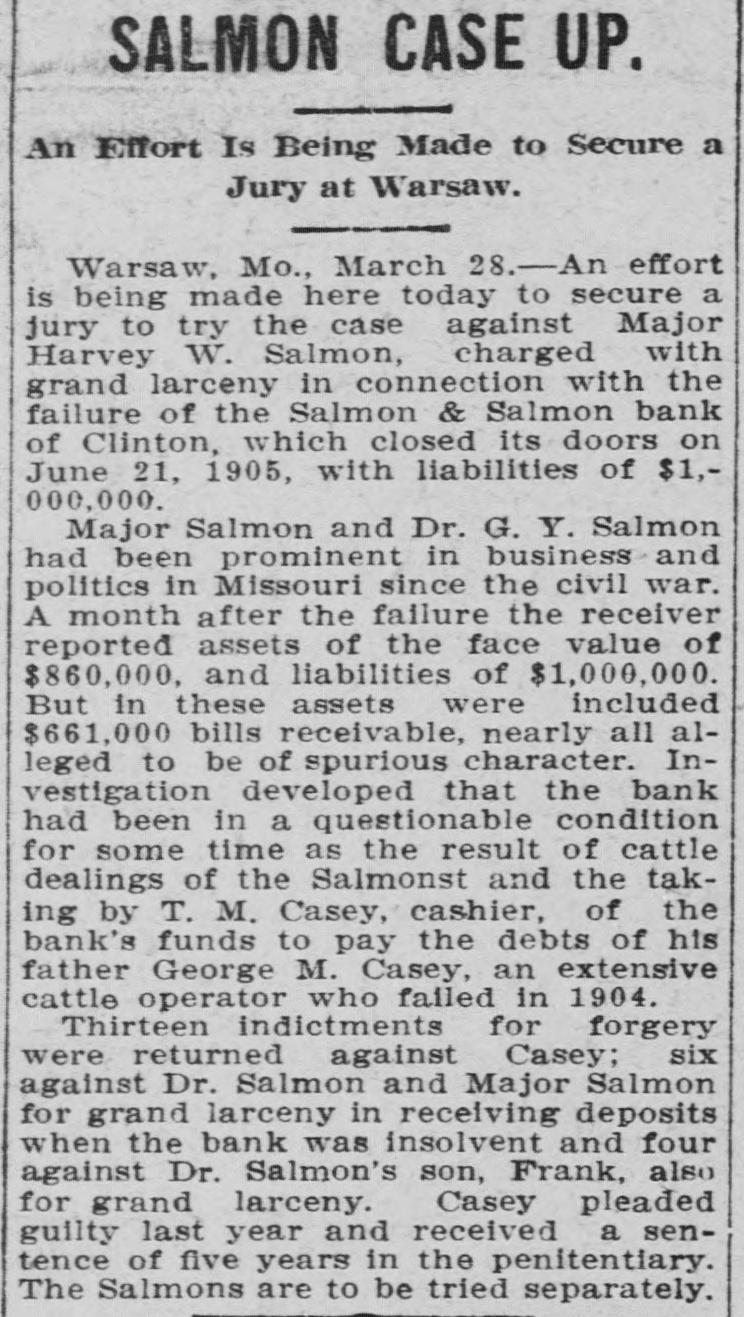
SALMON CASE UP. An Effort Is Being Made to Secure a Jury at Warsaw. Warsaw, Mo., March 28.-An effort is being made here today to secure a jury to try the case against Major Harvey W. Salmon, charged with grand larceny in connection with the failure of the Salmon & Salmon bank of Clinton, which closed its doors on June 21, 1905, with liabilities of $1,000.000. Major Salmon and Dr. G. Y. Salmon had been prominent in business and politics in Missouri since the civil war. A month after the failure the receiver reported assets of the face value of $860,000, and liabilities of $1,000,000. But in these assets were included $661,000 bills receivable, nearly all alleged to be of spurious character. Investigation developed that the bank had been in a questionable condition for some time as the result of cattle dealings of the Salmonst and the taking by T. M. Casey, cashier, of the bank's funds to pay the debts of his father George M. Casey, an extensive cattle operator who failed in 1904. Thirteen indictments for forgery were returned against Casey; six against Dr. Salmon and Major Salmon for grand larceny in receiving deposits when the bank was insolvent and four against Dr. Salmon's son, Frank, also for grand larceny. Casey pleaded guilty last year and received a sentence of five years in the penitentiary. The Salmons are to be tried separately.


Article from Evening Times-Republican, March 28, 1907

Click image to open full size in new tab

Article Text

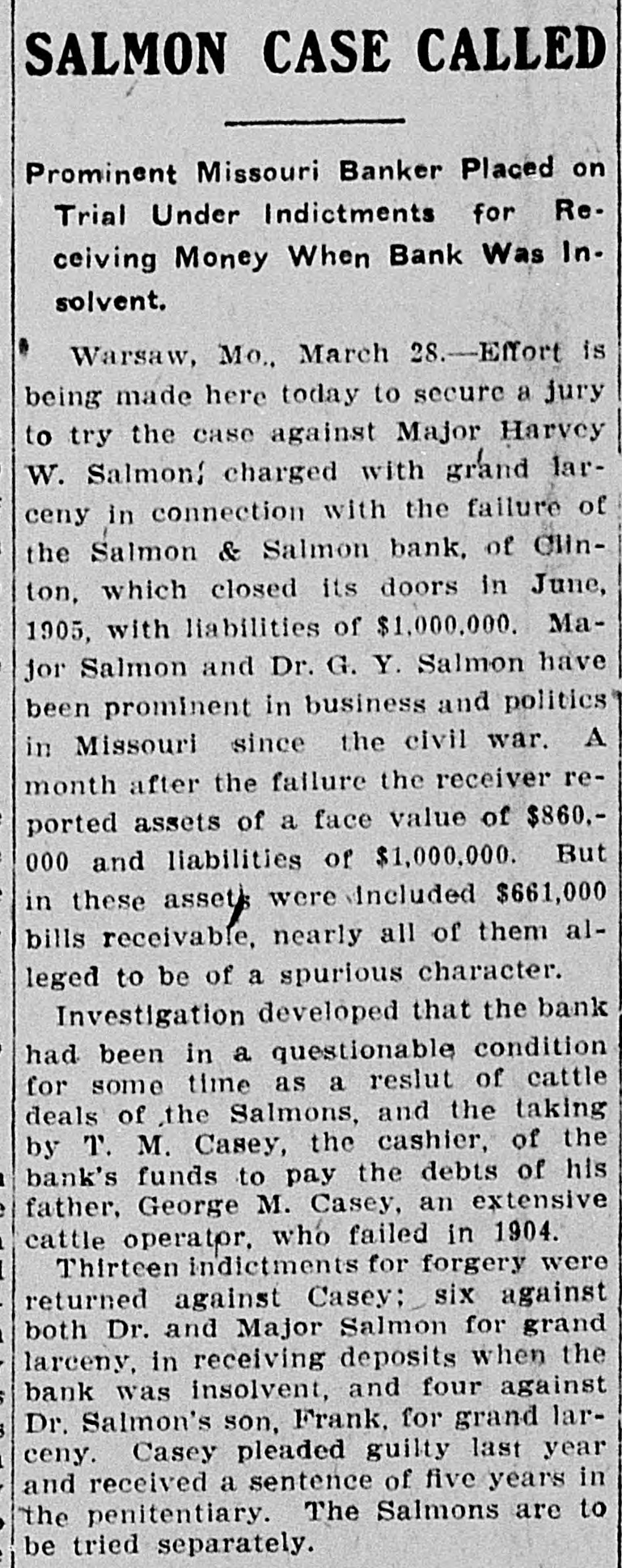
SALMON CASE CALLED Prominent Missouri Banker Placed on Trial Under Indictments for Receiving Money When Bank Was Insolvent. Warsaw, Mo., March S.-Effort is being made here today to secure a jury to try the case against Major Harvey W. Salmon; charged with grand larceny in connection with the failure of the Salmon & Salmon bank, of Clinton, which closed its doors in June, 1905, with liabilities of $1,000,000. Major Salmon and Dr. G. Y. Salmon have been prominent in business and politics in Missouri since the civil war. A month after the failure the receiver reported assets of a face value of $860.000 and liabilities of $1,000,000. But in these assets were included $661,000 bills receivable, nearly all of them alleged to be of a spurious character. Investigation developed that the bank had been in a questionable condition for some time as a reslut of cattle deals of the Salmons, and the taking by T. M. Casey, the cashier, of the bank's funds to pay the debts of his father, George M. Casey, an extensive cattle operator. who failed in 1904. Thirteen indictments for forgery were returned against Casey; six against both Dr. and Major Salmon for grand larceny, in receiving deposits when the bank was insolvent, and four against Dr. Salmon's son, Frank, for grand larceny. Casey pleaded guilty last year and received a sentence of five years in the penitentiary. The Salmons are to be tried separately.


Article from The Salt Lake Herald, March 29, 1907

Click image to open full size in new tab

Article Text

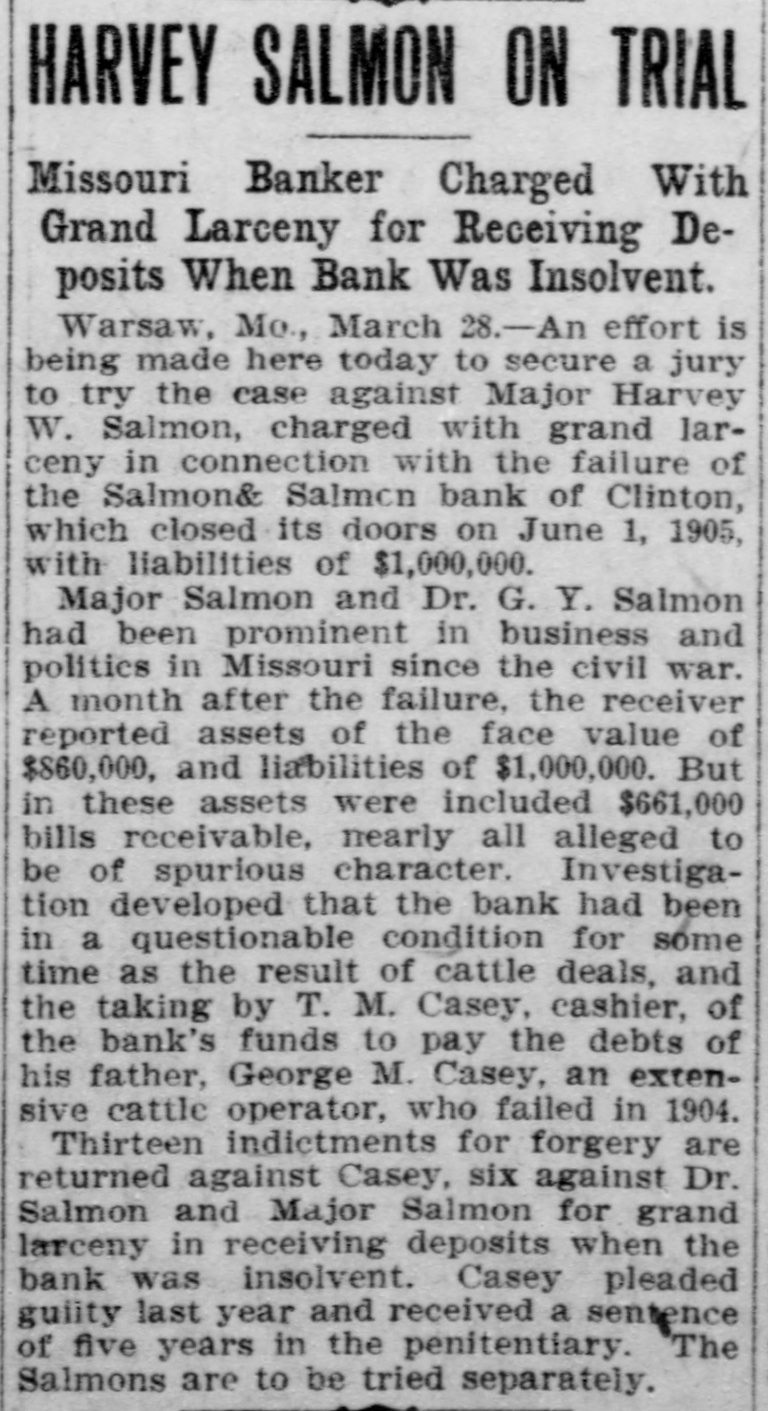
HARVEY SALMON ON TRIAL Missouri Banker Charged With Grand Larceny for Receiving Deposits When Bank Was Insolvent. Warsaw, Mo., March 28.-An effort is being made here today to secure a jury to try the case against Major Harvey W. Salmon, charged with grand larceny in connection with the failure of the Salmon& Salmon bank of Clinton, which closed its doors on June 1, 1905, with liabilities of $1,000,000. Major Salmon and Dr. G. Y. Salmon had been prominent in business and polities in Missouri since the civil war. A month after the failure, the receiver reported assets of the face value of $860,000, and liabilities of $1,000,000. But in these assets were included $661,000 bills receivable, nearly all alleged to be of spurious character. Investigation developed that the bank had been in a questionable condition for some time as the result of cattle deals, and the taking by T. M. Casey, cashier, of the bank's funds to pay the debts of his father, George M. Casey, an extensive cattle operator, who failed in 1904. Thirteen indictments for forgery are returned against Casey, six against Dr. Salmon and Major Salmon for grand larceny in receiving deposits when the bank was insolvent. Casey pleaded guiity last year and received a sentence of five years in the penitentiary. The Salmons are to be tried separately.


Article from Omaha Daily Bee, March 29, 1907

Click image to open full size in new tab

Article Text

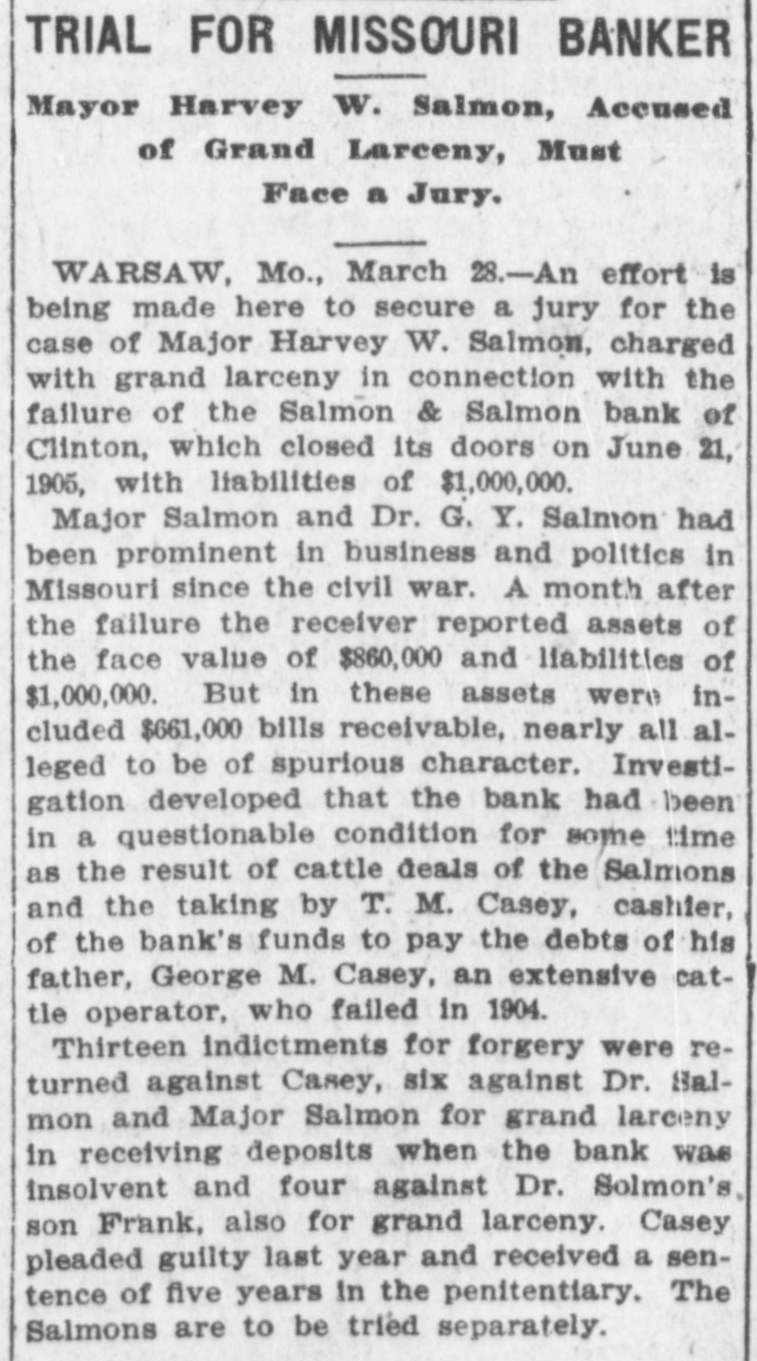
TRIAL FOR MISSOURI BANKER Mayor Harvey W. Salmon, Accused of Grand Larceny, Must Face a Jury. WARSAW, Mo., March 28.-An effort is being made here to secure a jury for the case of Major Harvey W. Salmon, charged with grand larceny in connection with the failure of the Salmon & Salmon bank of Clinton, which closed its doors on June 21, 1905, with liabilities of $1,000,000. Major Salmon and Dr. G. Y. Salmon had been prominent in business and politics in Missouri since the civil war. A month after the failure the receiver reported assets of the face value of $860,000 and liabilities of $1,000,000. But in these assets were included $661,000 bills receivable, nearly all alleged to be of spurious character. Investigation developed that the bank had been in a questionable condition for some time as the result of cattle deals of the Salmons and the taking by T. M. Casey, cashier, of the bank's funds to pay the debts of his father, George M. Casey, an extensive cattle operator, who failed in 1904. Thirteen indictments for forgery were returned against Casey, six against Dr. Salmon and Major Salmon for grand larceny in receiving deposits when the bank was insolvent and four against Dr. Solmon's, son Frank, also for grand larceny. Casey pleaded guilty last year and received a sentence of five years in the penitentiary. The Salmons are to be tried separately.


Article from The Dakota Chief, April 4, 1907

Click image to open full size in new tab

Article Text

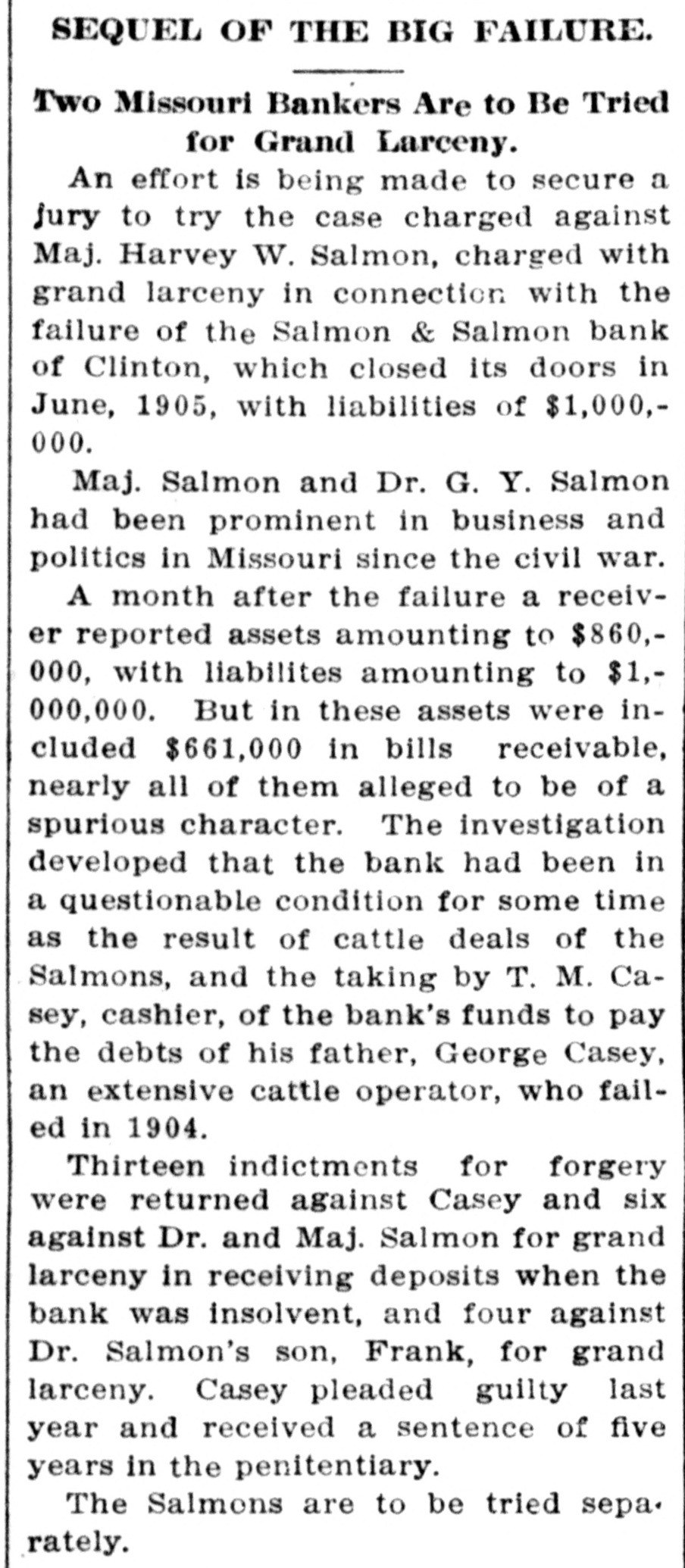
SEQUEL OF THE BIG FAILURE. Two Missouri Bankers Are to Be Tried for Grand Larceny. An effort is being made to secure a jury to try the case charged against Maj. Harvey W. Salmon, charged with grand larceny in connection with the failure of the Salmon & Salmon bank of Clinton, which closed its doors in June, 1905, with liabilities of $1,000,000. Maj. Salmon and Dr. G. Y. Salmon had been prominent in business and politics in Missouri since the civil war. A month after the failure a receiver reported assets amounting to $860,000, with liabilites amounting to $1,000,000. But in these assets were included $661,000 in bills receivable, nearly all of them alleged to be of a spurious character. The investigation developed that the bank had been in a questionable condition for some time as the result of cattle deals of the Salmons, and the taking by T. M. Casey, cashier, of the bank's funds to pay the debts of his father, George Casey, an extensive cattle operator, who failed in 1904. Thirteen indictments for forgery were returned against Casey and six against Dr. and Maj. Salmon for grand larceny in receiving deposits when the bank was insolvent, and four against Dr. Salmon's son, Frank, for grand larceny. Casey pleaded guilty last year and received a sentence of five years in the penitentiary. The Salmons are to be tried sepa. rately.