State Bank (New York, NY)

Episode Information

Episode UID
1009671380
Episode Type
Run Only
Bank Type
state
Bank ID
100967 routing
Routing Number
1-0096
Start Date
December 4, 1914
Location
New York, New York (40.714, -74.006)

Metadata

Model
gpt-5-mini (chosen from majority vote of a three-model LLM ensemble)
Short Digest
9c2c23c49d027b80

Response Measures

None

Events (1)

1. December 4, 1914 Run
Cause
Local Banks
Cause Details
Run spurred by failure/distress of local private bankers (A. L. Kass and related closures) and ensuing East Side hysteria.
Measures
Paid depositors throughout the day, waived the usual sixty-day notice in practice, used extra tellers and allowed redeposits; National City Bank offered a loan.
Newspaper Excerpt
Runs continued on the Public Bank ... and the State Bank, at Grand and Orchard sts., yesterday. Lines of overanxious depositors began to form in front of the two institutions as early as 2 o'clock in the morning.
Source
newspapers

Newspaper Articles (8)

Article from New-York Tribune, August 4, 1914

Click image to open full size in new tab

Article Text

60-DAY CLAUSE AIDS MONEY HERE Savings Banks Adopt the Richards Plan in Meeting Depositors. MANY WISH TO PAY IN FULL ON DEMAND Two East Side Institutions Taken Over by State-Situation Well in Hand. The enforcement yesterday by all the savings banks of the city of the banking law clause requiring sixty days' notice from depositors before withdrawals of funds would be allowed had its contributing effect toward relieving the strain of the money situation as a result of the European war. The action was taken by the boards of the various banks at the suggestion of Eugene Lamb Richards, State Superintendent of Banks. The officials of the banks who are members of the New York Savings Bank Association met at the office of the State Superintendent and adopted a resolution requiring the enforcement of the sixty-day clause. Mr. Richards extended his request to all savings banks in the state, as well as private banks, which have been under the control of the State Banking Department since August 1. He sent the following letter to the presidents of all savings banks outside the city: "In view of the European situation and for the purpose of conserving currency for our domestic needs, request that forthwith a resolution be adopted by your board of directors requiring a notice of sixty days before repaying deposits, and in otherwise complying with subdivision 1, Section 248 of the banking law. "The giving of the notice was not to help any institution or institutions," he said, "but was caused solely by the unique and extraordinary conditions prevailing in Europe. The course adopted is the only available method of preventing large withdrawals of currency from the banks and from the country." Run on Banks Averted. The adoption of the sixty-day clause had the immediate effect of shutting off the abnormal withdrawals which some of the savings banks experienced in the last few days. There was no disorder or early runs prior to the posting of the sixty-day clause notice, at any of the larger banks. Small runs were experienced at several East Side private banks. They were met with a high degree of confidence by the private bankers and depositors were paid promptly on demand in most cases. Following a report from state bank examiners, State Superintendent Richards took charge of the affairs of two East Side private banks, that controlled by M. & L. Jarmulowsky, at 165 East Broadway and that of Adolph Mandel, at 155 Rivington st. Both of these institutions had experienced small runs during the day. Superintendent Rich. ards announced that he would liquidate the affairs of both banks. In adopting the sixty-day clause it was decided to permit the banks to pay out small amounts in cases of emergeney. Most of the banks limited this amount to $50, but some paid $100, and one or two paid depositors wishing to withdraw in full. The Metropolitan, the Dry Dock, the Bowery and several other of the larger banks paid out considerable sums to depositors early in the day prior to posting the sixty-day notice as a result of which some de positors who came later were disgruntled over getting the small amounts on their deposits. A compar atively small number of notices of withdrawal of accounts at the end of sixty days were served by depositors at any of the savings banks. The Seaman's Bank for Savings, at 74 Wall st., which is not a member of the New York Savings Bank Associa tion, enforced the sixty-day clause at the request of the State Superinten dent Officials of the bank said yes terday that they had not intended to take advantage of the clause, but had done so when personally requested by Superintendent Richards. About five hundred depositors called at the bank during the day for their savings, and those who were not satisfied with the explanation of the sixty-day clause by the officials were paid in full. Only thirty nine notices of withdrawals of accounts were left by depositors at this bank. Money Ready for Soldiers. Natives of the European countries at war who had received official notice for service as reserves were paid in full in most instances where they presented such notices to the bank officials. While there is little prospect of these "reserves" getting back to their native land on any ship at the present time, it was explained that they had to report to their consuls every day and be prepared for the first possible sailing. In the Williamsburg section there were runs on two banks, one of which, at the bank of A. L. Kass, 87 Graham av. required the calling of the reserves from the Stagg st. station to preserve order. Depositors were permitted to withdraw from $5 to $10 each. A small run started at the illiamsburg branch of the State Bank, but soon simmered out when William Walton, the manager, announced that all depositors could draw out their full amounts if desired. SO they There are 140 savings banks in New York State. Their financial statements to the State Banking Department on January showed 3,143,044 depositors, with $1,741,697,462 to their credit. The total resources were given as $1,926,334,331. There are ninety private banks, whose figures are not obtainable owing to the short period that these institutions have been under the supervision of the State Banking Department. State Superintendent Richards sent out notice to all private bankers doing business under the laws of the State Banking Department that from now until further notice they will have to close their banks at 3 p. m. It had been the practice of many of the small private banks to keep open during the evening and in some instances late at night. All private banks that failed to file their application to
Article from New-York Tribune, December 4, 1914

Click image to open full size in new tab

Article Text

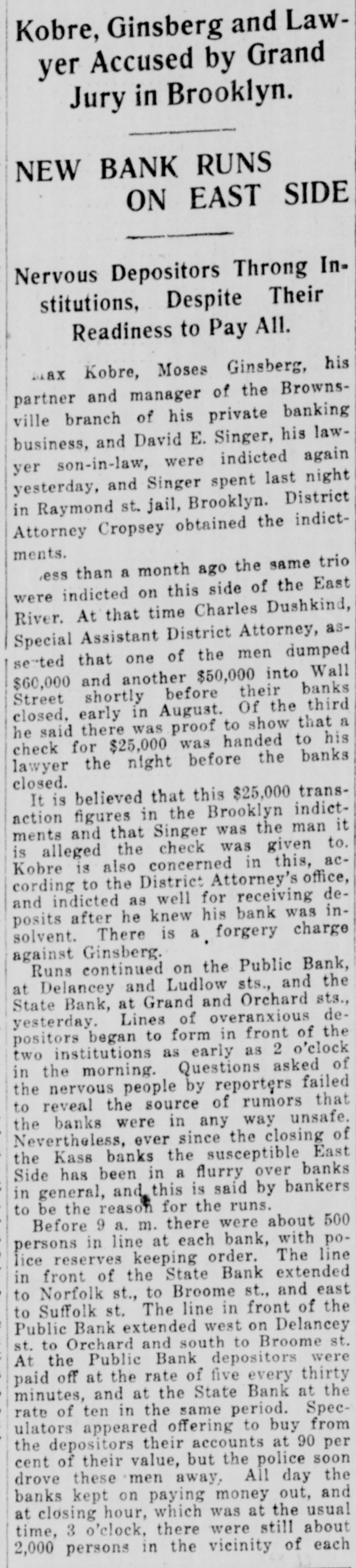
Kobre, Ginsberg and Lawyer Accused by Grand Jury in Brooklyn. NEW BANK RUNS ON EAST SIDE Nervous Depositors Throng Institutions, Despite Their Readiness to Pay All. max Kobre, Moses Ginsberg, his partner and manager of the Brownsville branch of his private banking business, and David E. Singer, his lawyer son-in-law, were indicted again yesterday, and Singer spent last night in Raymond st. jail, Brooklyn. District Attorney Cropsey obtained the indictments. ess than a month ago the same trio were indicted on this side of the East River. At that time Charles Dushkind, Special Assistant District Attorney, asserted that one of the men dumped $60,000 and another $50,000 into Wall Street shortly before their banks closed, early in August. Of the third he said there was proof to show that a check for $25,000 was handed to his lawyer the night before the banks closed. It is believed that this $25,000 transaction figures in the Brooklyn indictments and that Singer was the man it is alleged the check was given to. Kobre is also concerned in this, according to the District Attorney's office, and indicted as well for receiving deposits after he knew his bank was insolvent. There is a. forgery charge against Ginsberg. Runs continued on the Public Bank, at Delancey and Ludlow sts., and the State Bank, at Grand and Orchard sts., yesterday. Lines of overanxious depositors began to form in front of the two institutions as early as 2 o'clock in the morning. Questions asked of the nervous people by reporters failed to reveal the source of rumors that the banks were in any way unsafe. Nevertheless, ever since the closing of the Kass banks the susceptible East Side has been in a flurry over banks in general, and this is said by bankers to be the reason for the runs. Before 9 a. m. there were about 500 persons in line at each bank, with police reserves keeping order. The line in front of the State Bank extended to Norfolk st., to Broome st., and east to Suffolk st. The line in front of the Public Bank extended west on Delancey st. to Orchard and south to Broome st. At the Public Bank depositors were paid off at the rate of five every thirty minutes, and at the State Bank at the rate of ten in the same period. Speculators appeared offering to buy from the depositors their accounts at 90 per cent of their value, but the police soon drove these men away, All day the banks kept on paying money out, and at closing hour, which was at the usual time, 3 o'clock, there were still about 2,000 persons in the vicinity of each


Article from New-York Tribune, December 4, 1914

Click image to open full size in new tab

Article Text

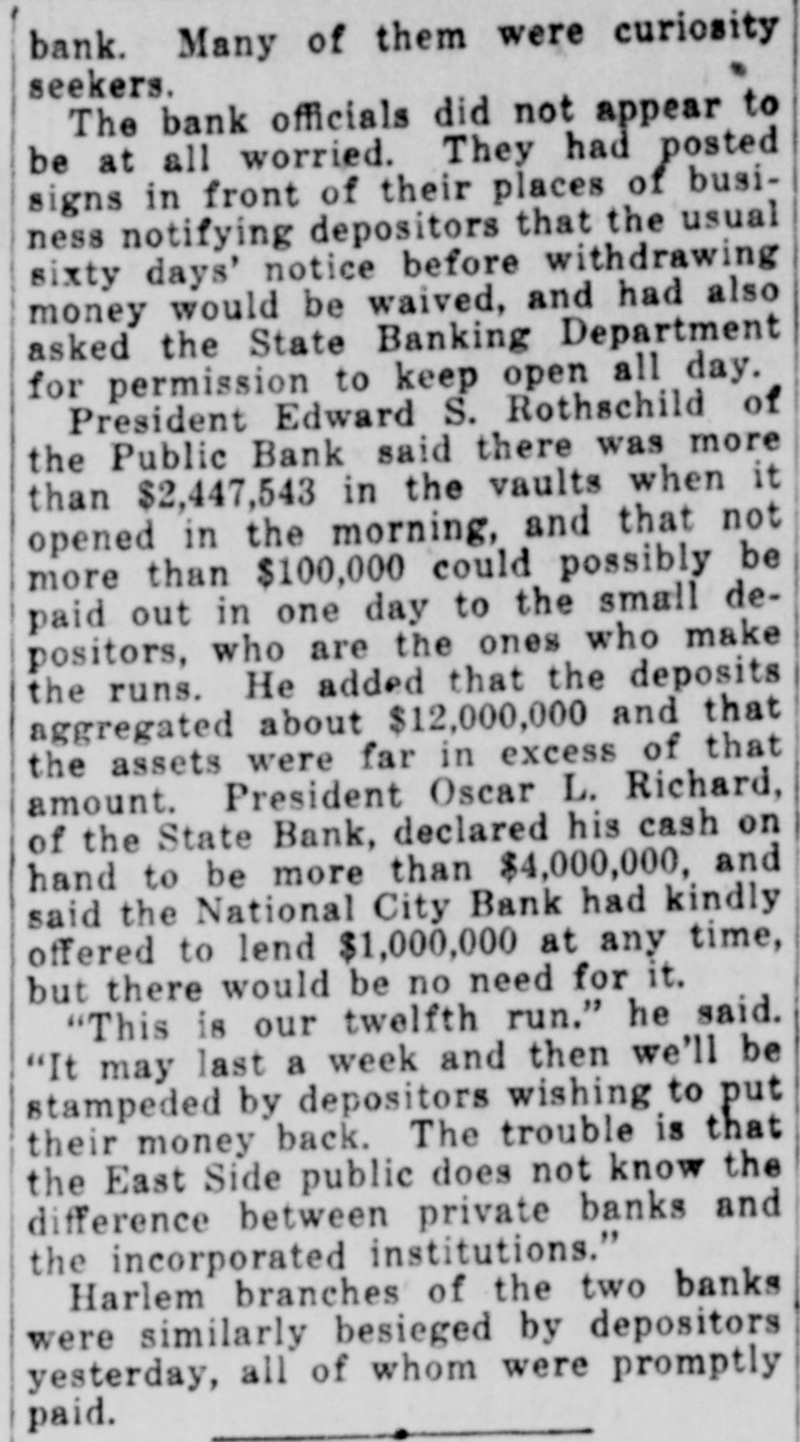
bank. Many of them were curiosity seekers. The bank officials did not appear to be at all worried. They had posted signs in front of their places of business notifying depositors that the usual sixty days' notice before withdrawing money would be waived, and had also asked the State Banking Department for permission to keep open all day. President Edward S. Rothschild of the Public Bank said there was more than $2,447,543 in the vaults when it opened in the morning, and that not more than $100,000 could possibly be paid out in one day to the small depositors, who are the ones who make the runs. He added that the deposits aggregated about $12,000,000 and that the assets were far in excess of that amount. President Oscar L. Richard, of the State Bank, declared his cash on hand to be more than $4,000,000, and said the National City Bank had kindly offered to lend $1,000,000 at any time, but there would be no need for it. "This is our twelfth run." he said. "It may last a week and then we'll be stampeded by depositors wishing to put their money back. The trouble is that the East Side public does not know the difference between private banks and the incorporated institutions." Harlem branches of the two banks were similarly besieged by depositors yesterday, all of whom were promptly paid.


Article from New-York Tribune, December 5, 1914

Click image to open full size in new tab

Article Text

EAST SIDE BANK HYSTERIA DYING Smaller Crowds Call for Money, and Confidence Is Being Restored. Dwindling crowds were the rule yesterday at the East Side banks which have been innocent victims of the hysteria. The feeling seemed to be prevalent that the worst was over and that the "stupid runs" would die a natural death. Max Kobre, head of the bankrupt chain of banks which bore his name, and Moses Ginsberg, his partner and manager of the Williamsburg branch, furnished $10,000 bail each yesterday when arraigned before County Judge Fawcett in Brooklyn. Both had been indicted the previous day. David E. Singer, son-in-law of Kobre, who spent Thursday night in Raymond st. jail, was released after giving a $5,000 bond. Although extra tellers worked all day yesterday paying depositors of the Public Bank, at Ludlow and Delancey sts and the State Bank, at 52 Norfolk st., and their branches in Harlem, only one case of extreme disorder was noted. William Geister, of 356 Hewes st., Brooklyn, tried to force his way into the Public Bank and started a fight when turned back to the end of the line. Several depositors joined the scuffle and were repulsed by police reinforcements. Geiser was locked up in the Clinton st. station, as was Meyer Fine, of 97 Monroe st., accused of trying to aid him to escape. At the banks and branches named all who applied for their money got it. There was no attempt to temporize, but rather to facilitate the withdrawal of deposits. The moral effect of this attitude was not lost on the men and women in line.


Article from The Evening World, December 5, 1914

Click image to open full size in new tab

Article Text

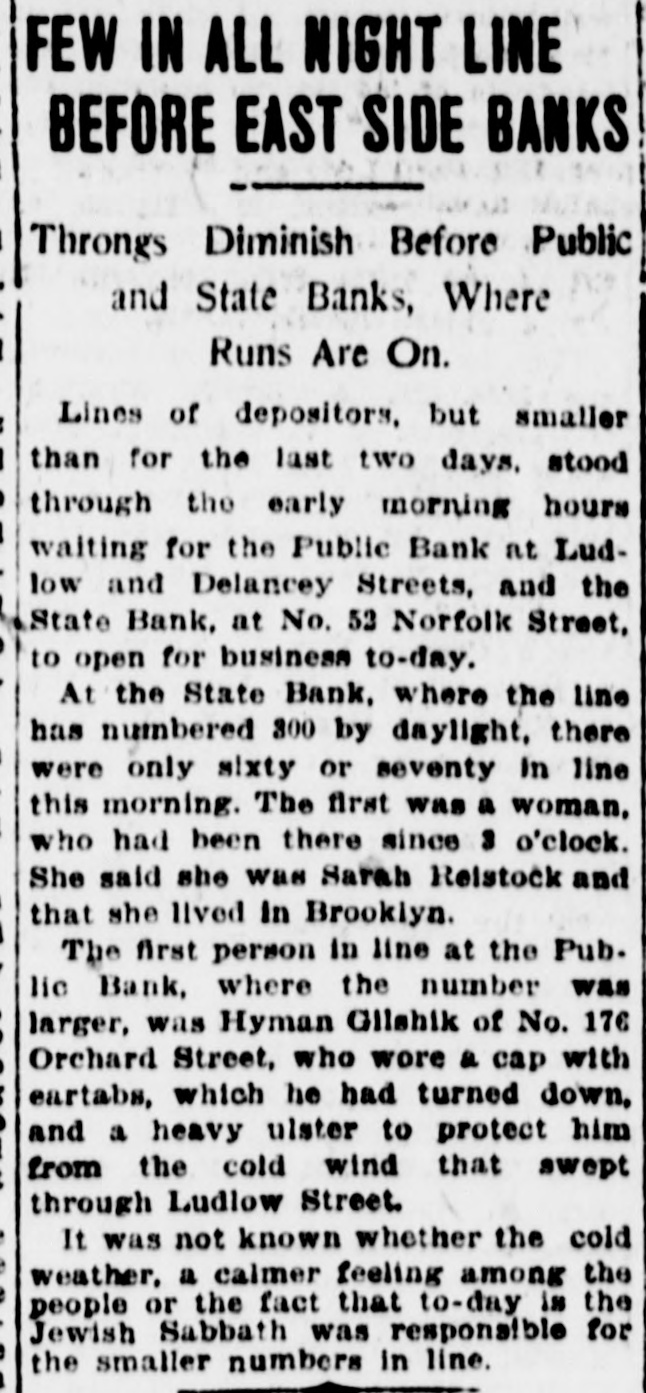
FEW IN ALL NIGHT LINE BEFORE EAST SIDE BANKS Throngs Diminish Before Public and State Banks, Where Runs Are On. Lines of depositors, but smaller than for the last two days. stood through the early morning hours waiting for the Public Bank at Ludlow and Delancey Streets, and the State Bank, at No. 52 Norfolk Street, to open for business to-day. At the State Bank, where the line has numbered 300 by daylight, there were only sixty or seventy in line this morning. The first was a woman, who had been there since 3 o'clock. She said she was Sarah Reistock and that she lived in Brooklyn. The first person in line at the Pub. lic Bank, where the number was larger, was Hyman Gllshik of No. 176 Orchard Street, who wore a cap with eartabs, which he had turned down, and a heavy ulster to protect him from the cold wind that swept through Ludlow Street. It was not known whether the cold weather, a calmer feeling among the people or the fact that to-day is the Jewish Sabbath was responsible for the smaller numbers in line.


Article from The Bridgeport Evening Farmer, December 8, 1914

Click image to open full size in new tab

Article Text

The run on the State bank in Brooklyn has ceased, many of the depositors redepositing their money.


Article from The Sun, December 8, 1914

Click image to open full size in new tab

Article Text

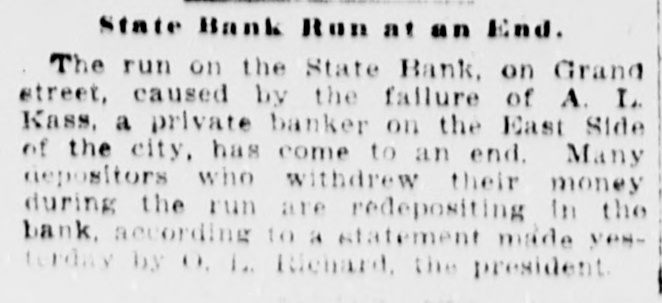
State Bank Run at an End. The run on the State Bank, on Grand street, caused by the failure of A. L. Kass, a private banker on the East Side of the city, has come to an end. Many depositors who withdrew their money during the run are redepositing in the bank, according to a statement made yesterday by O, L. Richard. the president.


Article from Norwich Bulletin, December 9, 1914

Click image to open full size in new tab

Article Text

The run on the State Bank in Brooklyn has ceased, many of the depositors redepositing their money.