Click image to open full size in new tab
Article Text
AFFAIRS IN NEW YORK.
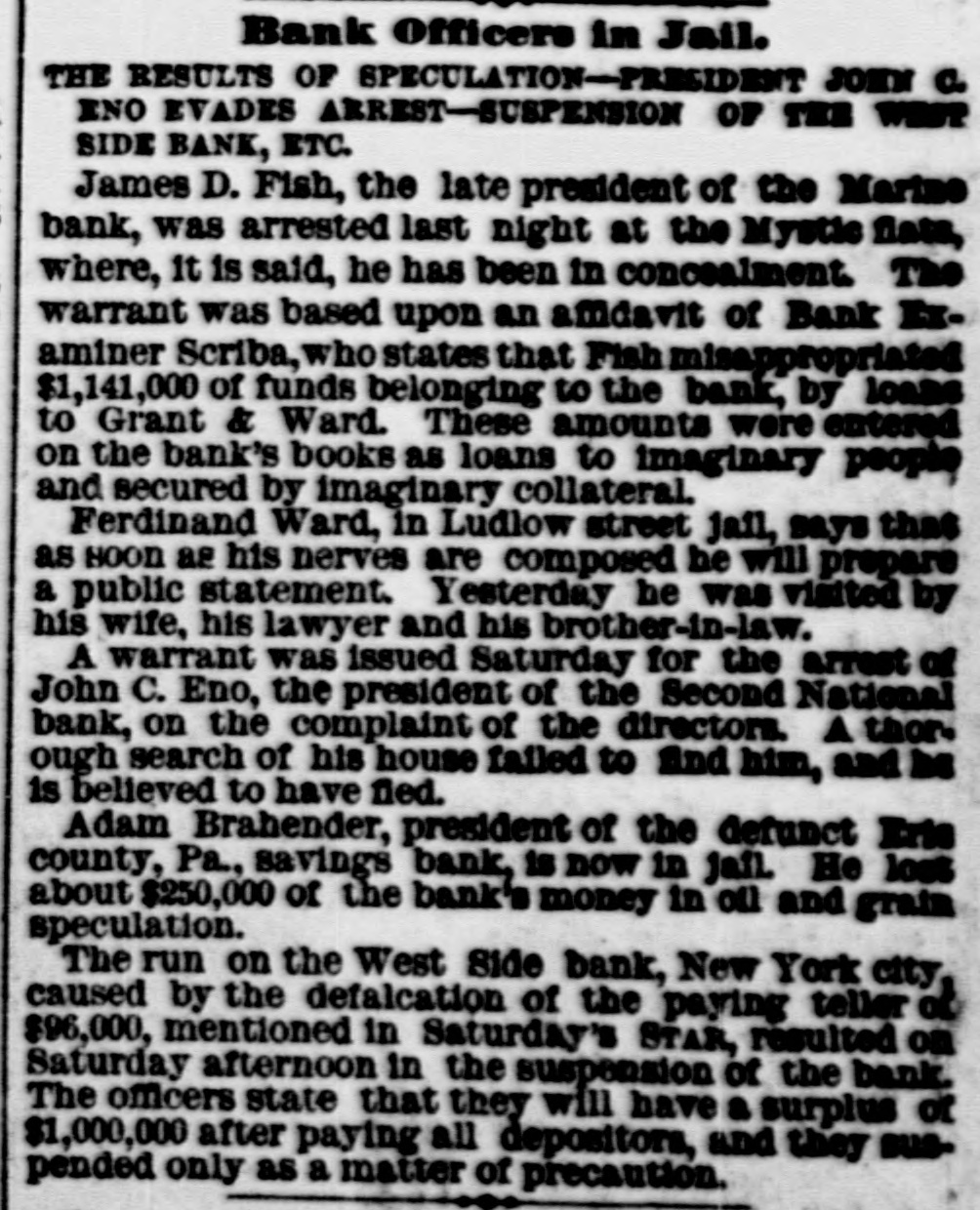
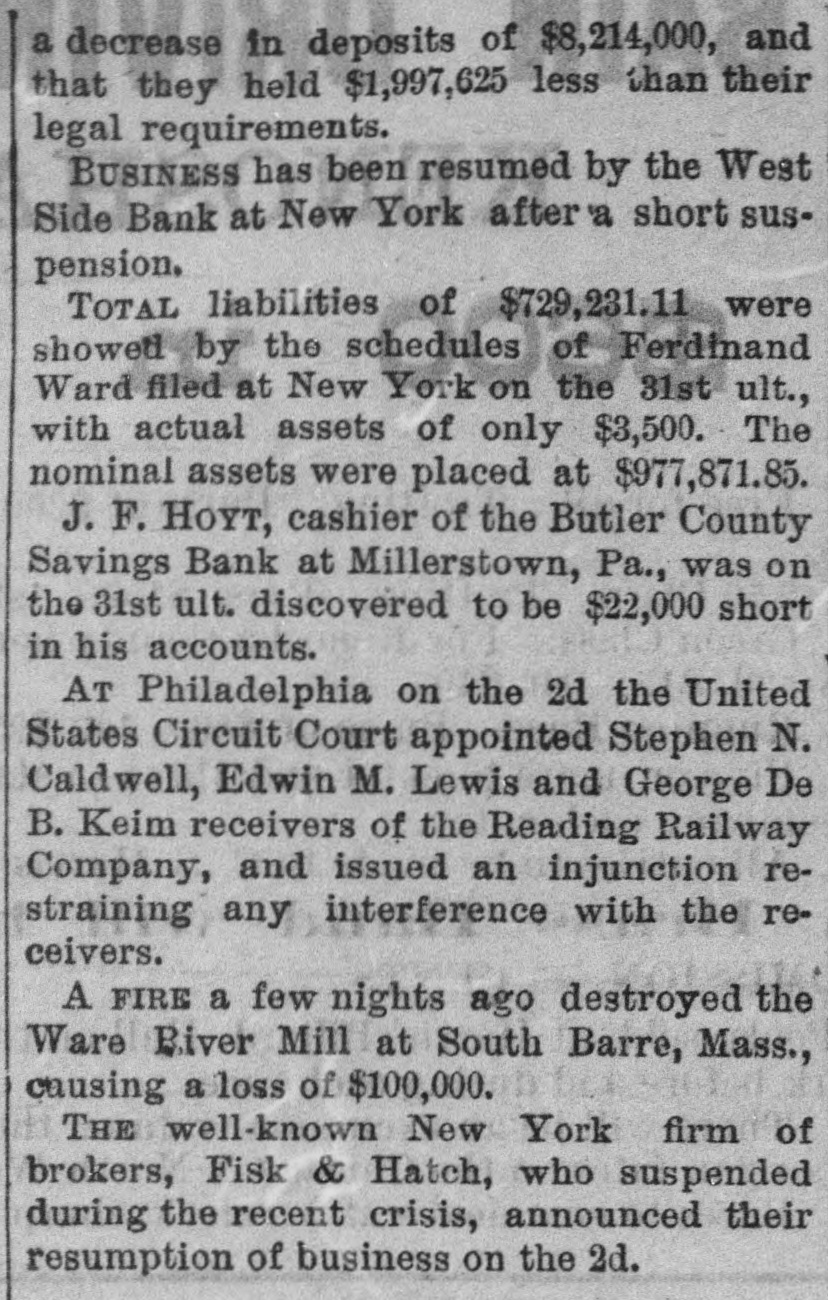
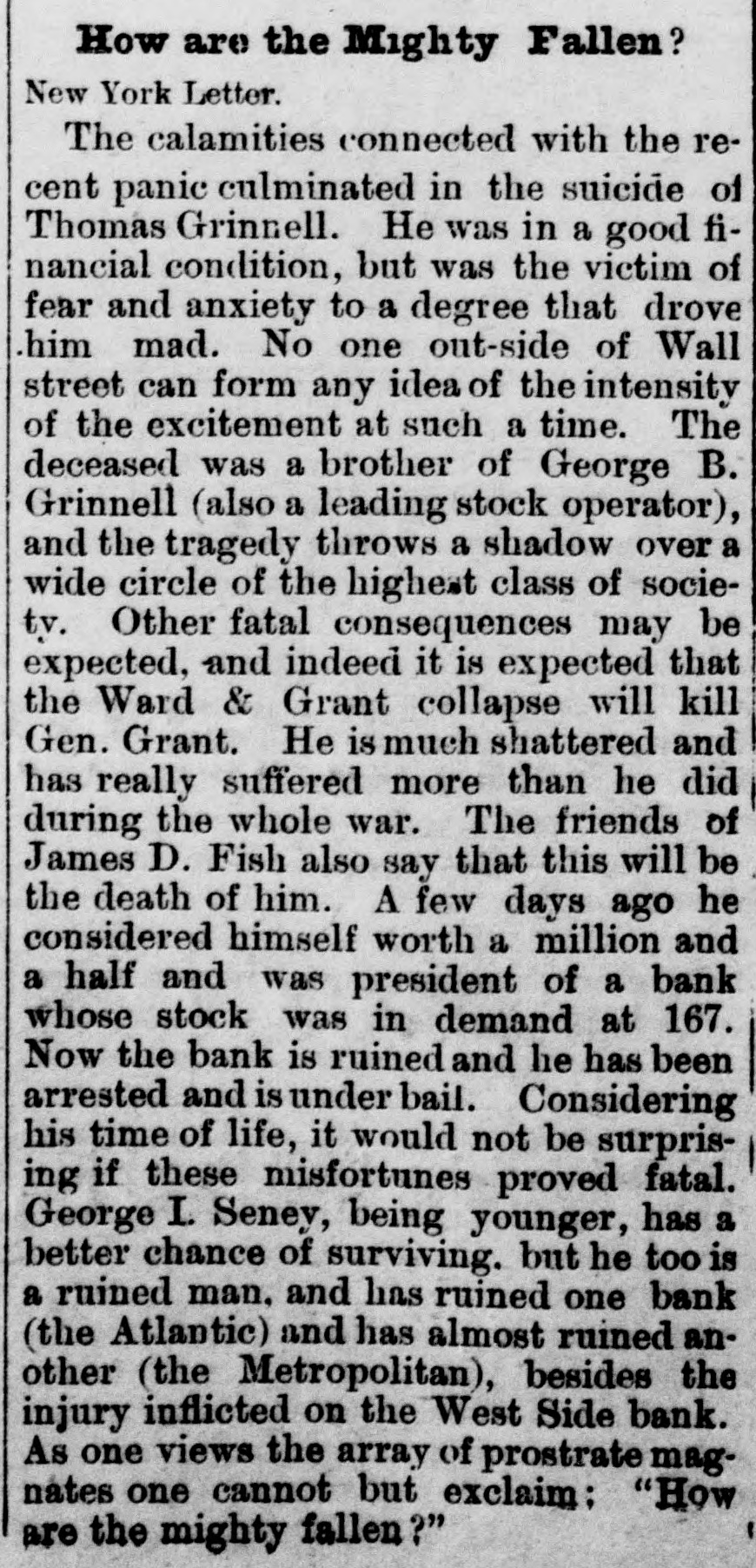
Warrants were issued in New York on Saturday by the U. S. authorities for the arrest of John C. Eno, late president of the Second National Bank, and James D. Fish, late president of the Marine National Bank. Two deputy marshals armed with the warrant for Mr. Eno visited his house in the afternoon, and after a parley with the servant succeeded in entering. The ladies of the household confronted them in the hall, and declared firmly that the deputies should not make the search, at the same time protesting that Mr. Eno was not in the house. They sent for a policeman to put the intruders out, but when that official arrived he declined to interfere. Various delays kept the marshal's officers in the parlor for an hour. Then they searched the house from bottom to top, but could find no trace of their man. It was rumored, among other things, that Mr. Eno left his house on Friday night under the very noses of the detectives, who saw him go without the least suspicion. It was said that during Friday evening two gentlemen and four ladies went out in a party, and that Mr. Eno was one of the ladies.
Mr. Fish was arrested shortly after midnight upon a warrant issued by a United States Commissioner. He was not taken before a magistrate, and is in the custody of the deputy marshal who made the arrest.
The warrant was issued upon an affidavit made by Augustus Scriba, the national bank examiner. He deposed, after a careful examination of the books of the Marine Bank, that President Fish had misappropriated funds belonging to the bank to the amount of $1,141,000. This was done between March 1 and May 6, 1884.
Ferdinand Ward has improved in health since his incarceration. He attributes the change to the rest and quiet of the jail and his freedom from tormenting creditors. Mr. Ward authorized the announcement that neither he nor his brother would have any statement to make for three or four days, but at that time he would publish a statement. He said: "I can assure the public that my intention to bring to light every fact it is in relation to my business transactions, and when I do so it will be backed by evidence that can be proved beyond a doubt. But until I have fully prepared myself I had rather not speak."
What is equivalent in some respects to a statement is contained in Ward's affidavit to the writ of Receiver Julian T. Davis against W. S. Warner, in which he says: "For a long time prior to its suspension said firm was insolvent, and known to me to be insolvent. During said period I carried on transactions with various persons for the purpose of obtaining money, in which, in substance, I represented or intimated that I or my said firm had opportunities to employ money and make large profits thereby in short periods of time in connection with government and city contracts, and mining and other speculations, by means of which I obtained from various persons loans or advances of money upon agreements that my said firm would repay the same with additional sums called profits at short periods of time, which so-called profits were usually percentages upon the amounts advanced, equivalent to interest at various excessive rates, varying with different persons from two to twenty per cent. a month."
On these transactions, he says, Warner paid him about $6,000,000, and he paid Warner about $7,800,000, and when the firm suspended Warner held similar contracts purporting to show that the firm owed him more than $2,500,000. He says that a short time after the transactions began Warner received back the entire advances he had made in such transactions, and then began to leave his fictitious profits to be reinvested until he developed a large apparent indebtedness to himself. Then Mr. Ward says: "On several occasions I applied to Warner to accept two per cent. a month as profits, instead of twenty per cent. a month, but said Warner refused to do so, threatening to draw out the entire amount claimed to be due him unless further similar transactions were carried on on the basis of profits of twenty per cent. a month.
Ward frankly admits that there were no contracts and that there were no methods of investment. He says that Warner never inquired what the contracts were or made any attempt to ascertain anything about them, and had his contracts drawn so as not to show the amount of profits paid.
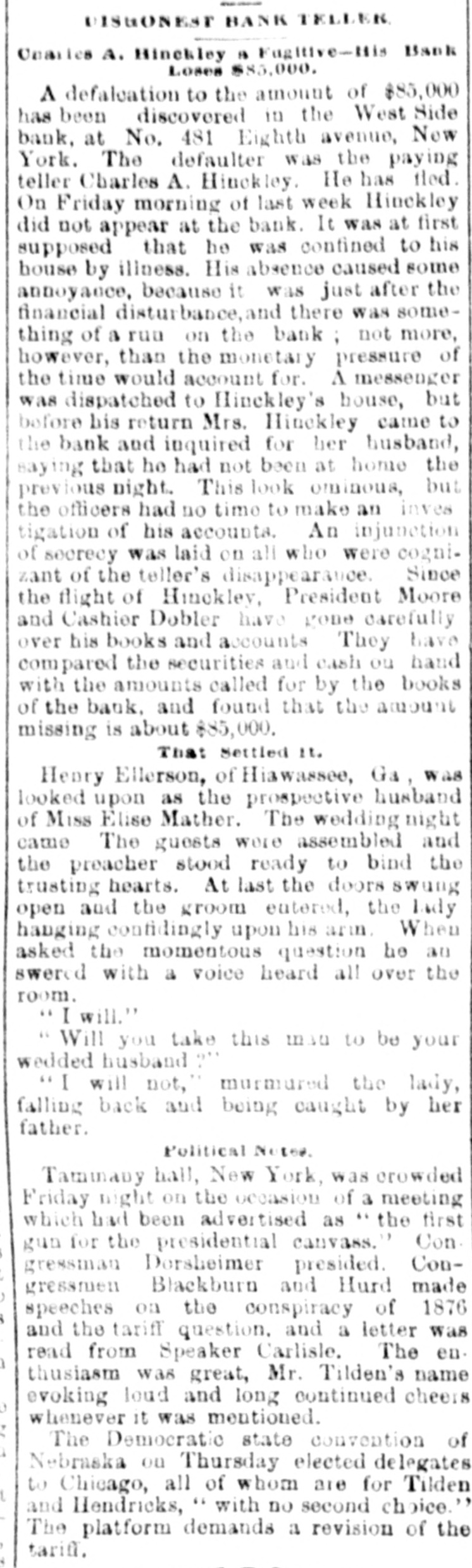
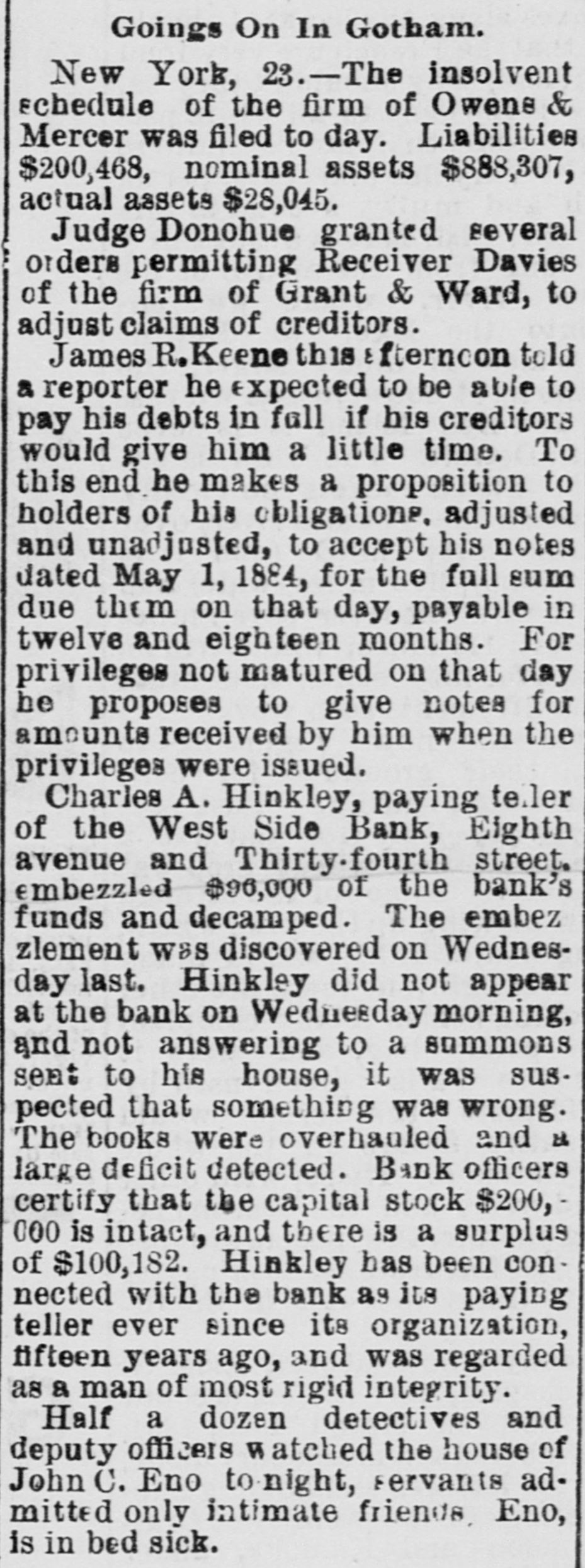
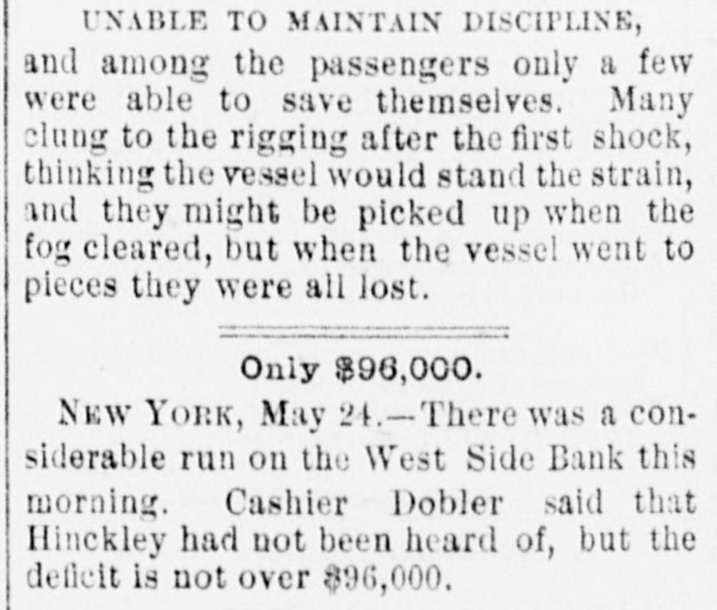
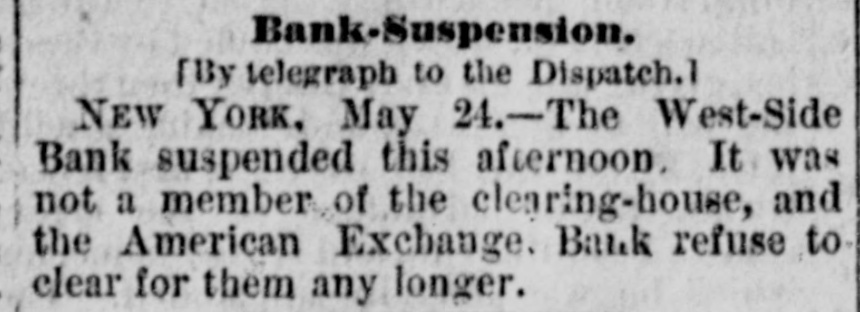
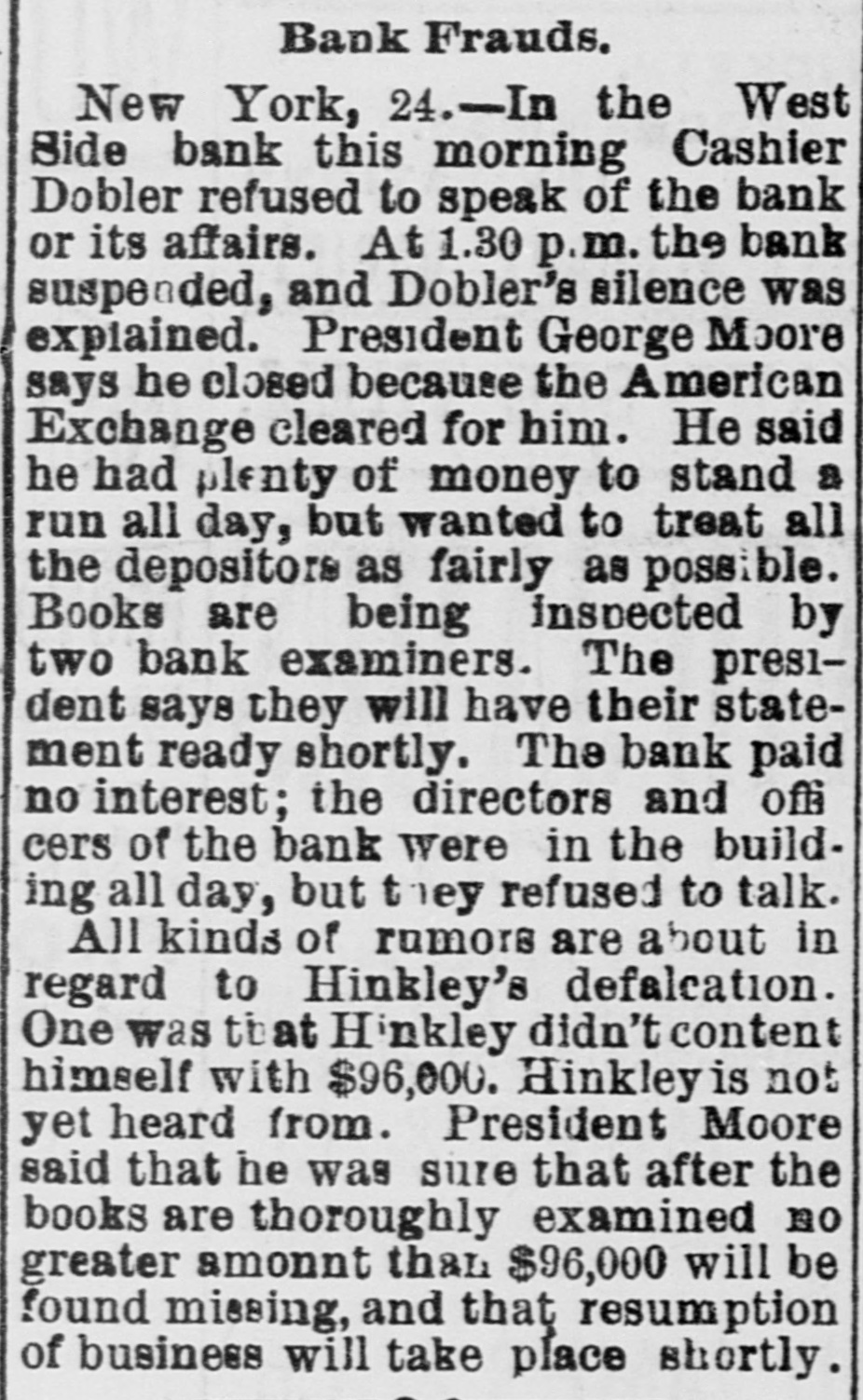
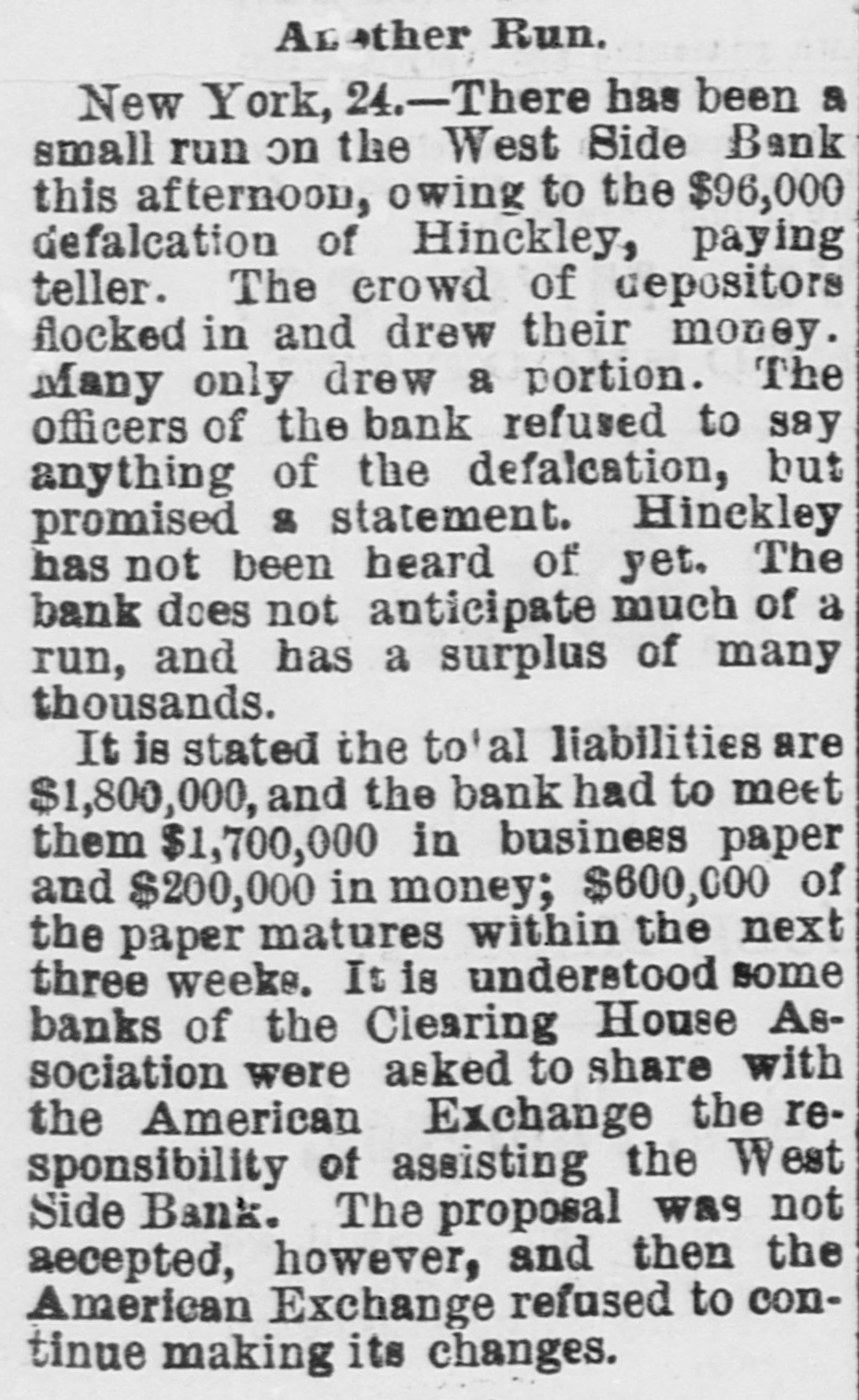
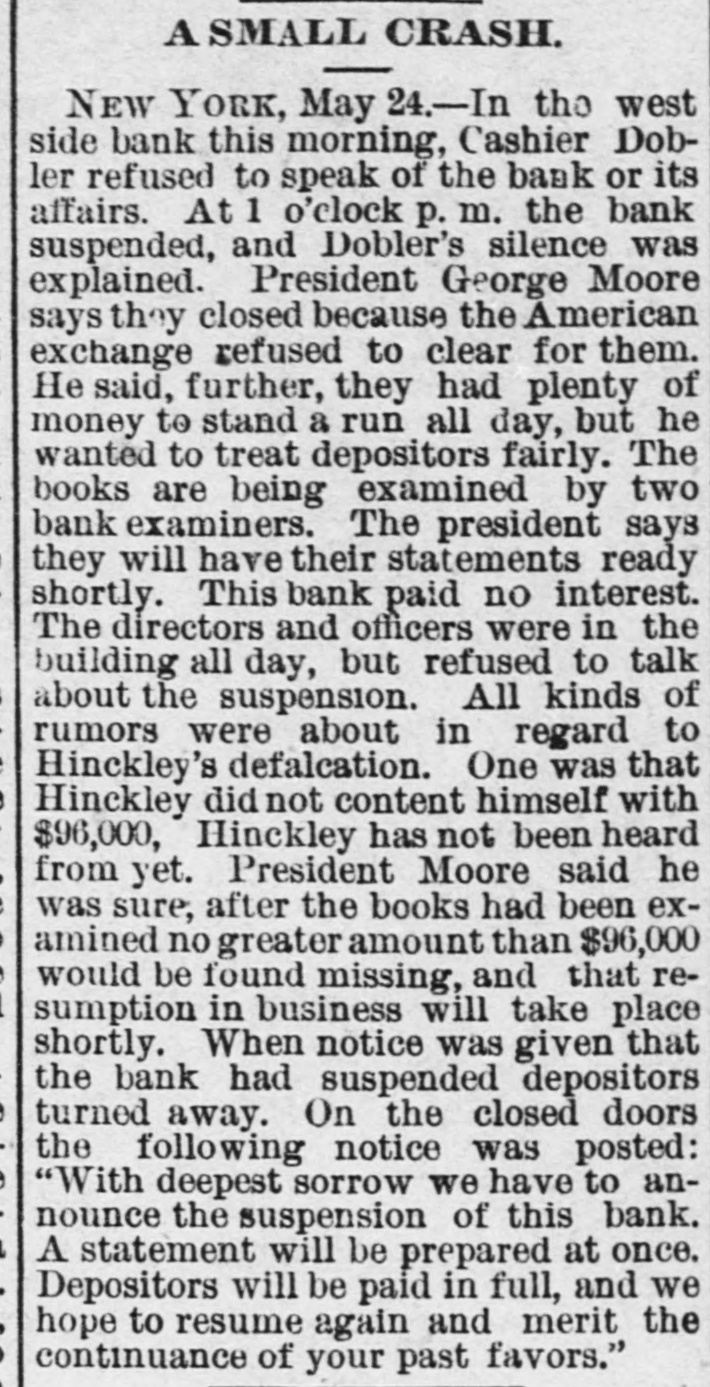
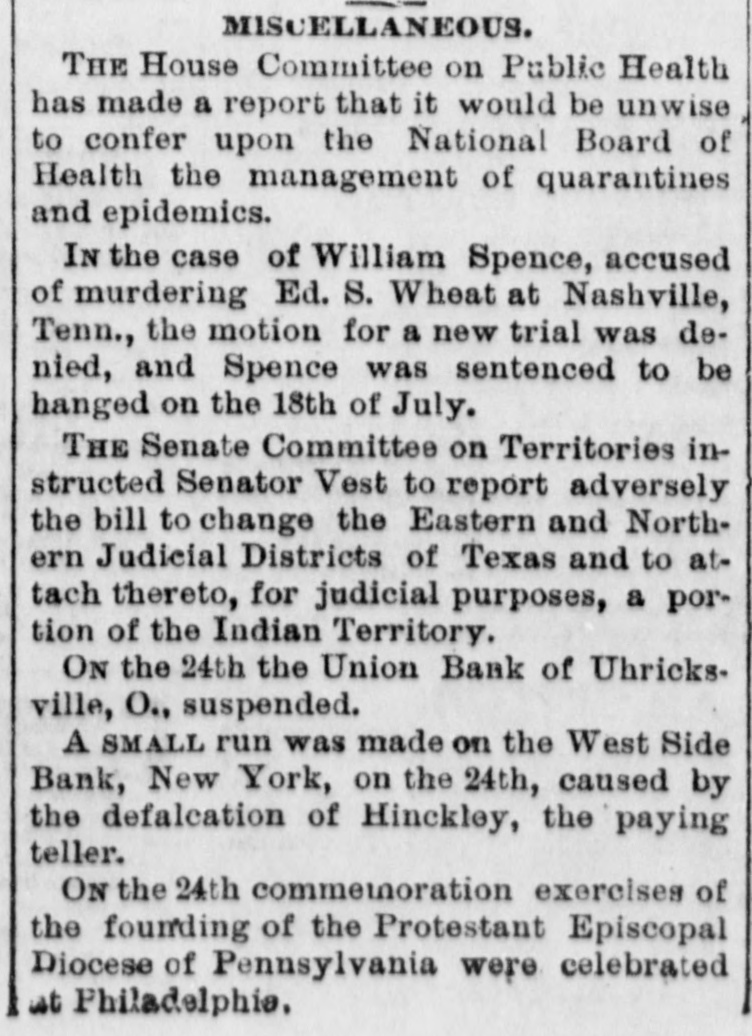
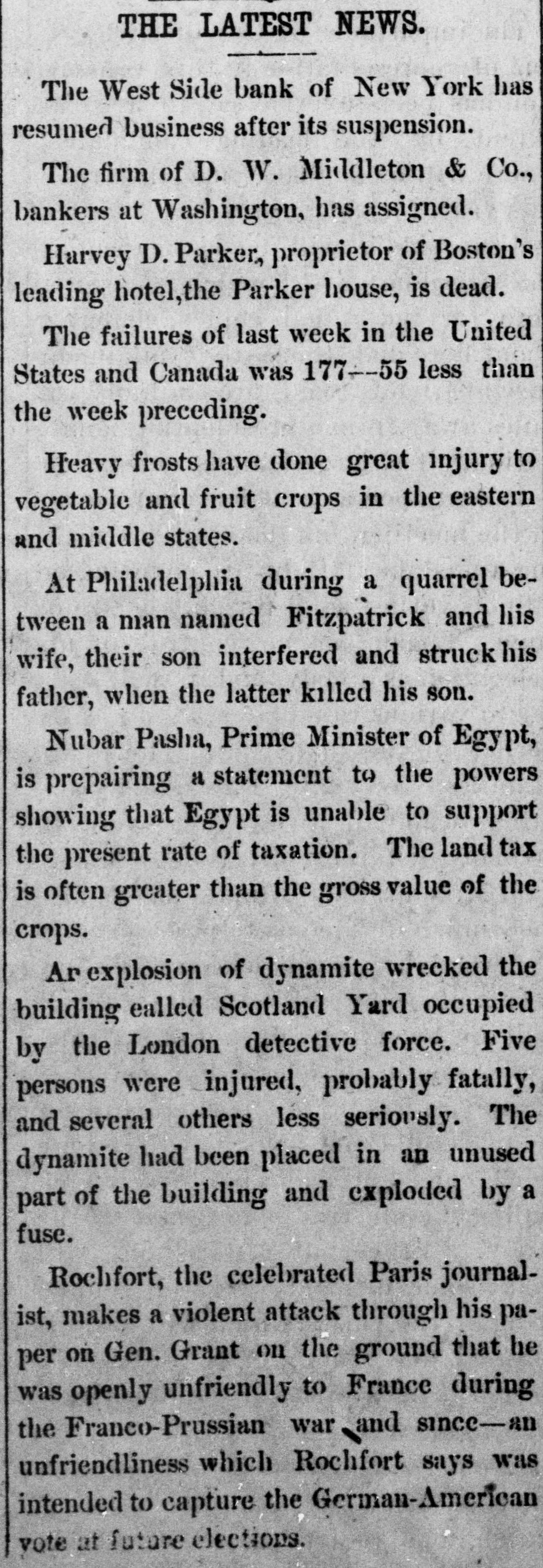
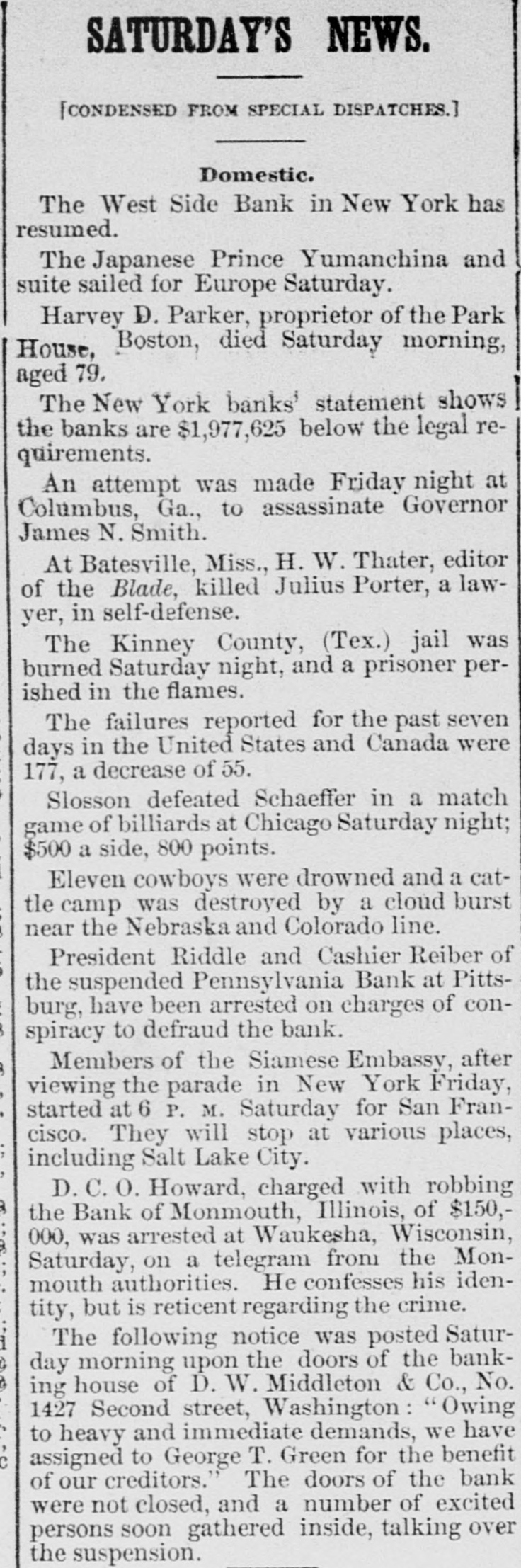
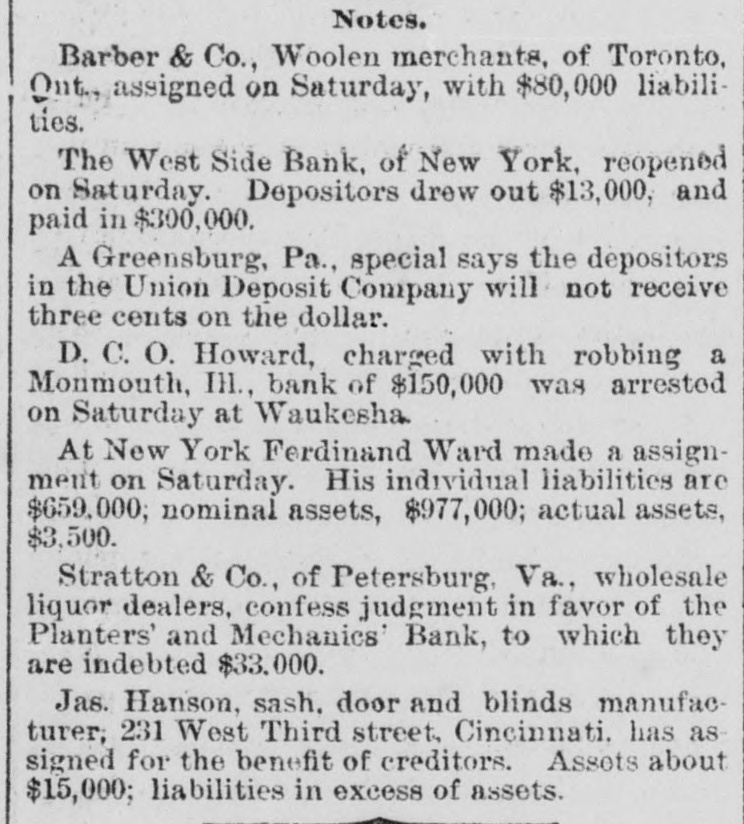
The West Side Bank, which was discovered on Friday to be the victim of Teller Hinckley's defalcation, suspended at 1.30 p. m. on Saturday. President Geo. Mason says they closed because the American Exchange refused to clear for them. He said further that they had plenty of money to stand the run all day, but he wanted to treat all the depositors fairly. The books are being inspected by two bank examiners.
THE CONFEDERATE HOME.
Owing, doubtless, to the unusual heat for this season of the year and the inopportune selection of the evening, the mass meeting held