Farmers National Bank (Chinook, MT)

Episode Information

Episode UID
1005301599
Episode Type
Suspension โ†’ Reopening
Bank Type
national
Bank ID
100530 national
Charter Number
10053
Start Date
March 4, 1933
Location
Chinook, Montana (48.590, -109.231)

Metadata

Model
gpt-5-mini (chosen from majority vote of a three-model LLM ensemble)
Short Digest
8e2a2583582e83a2

Response Measures

None

Description

Bank was closed under a 1933 banking holiday/conservation action and later placed under a conservator with plans to reopen.

Events (5)

1. July 14, 1911 Chartered
Source
historical_nic
2. March 4, 1933 Suspension
Cause
Government Action
Cause Details
Governor Erickson proclaimed an indefinite holiday for Montana banks following widespread banking holidays and a national decree by President Roosevelt.
Newspaper Excerpt
ORDER PARALYZES BANKS; AWAIT WORD TO REOPEN HOLIDAY FORCED UPON THIS STATE BY ACTION OF OTHERS
Source
newspapers
3. July 27, 1933 Other
Newspaper Excerpt
Assets To Report on Plans of Conservator for Bank Reopening Here
Source
newspapers
4. December 18, 1933 Voluntary Liquidation
Source
historical_nic
5. February 15, 1938 Other
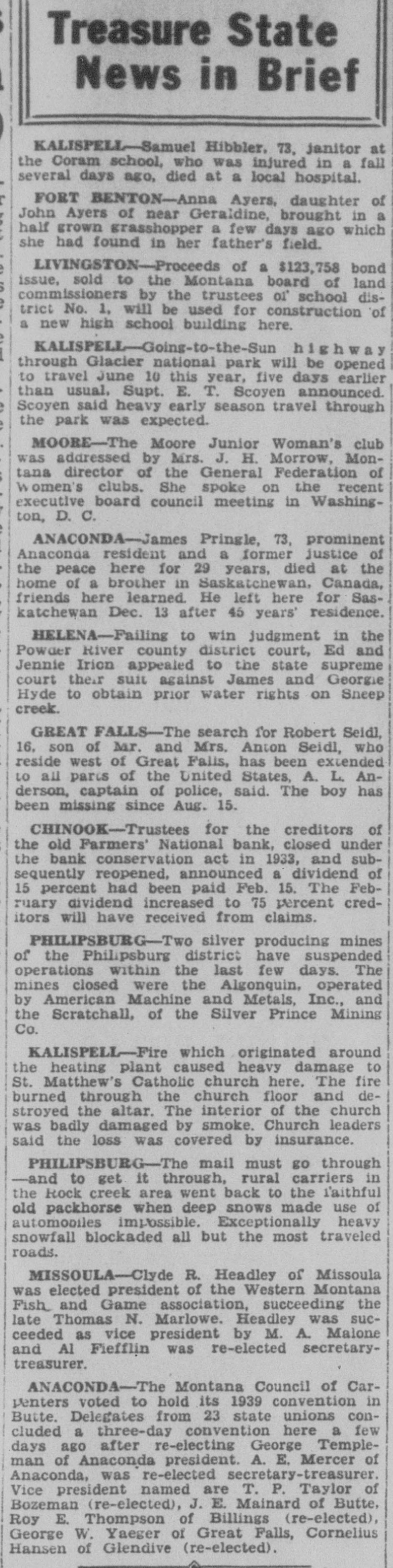
Newspaper Excerpt
Trustees for the creditors of the old Farmers' National bank, closed under the bank conservation act in 1933, and subsequently reopened, announced a dividend of 15 percent had been paid Feb. 15.
Source
newspapers

Newspaper Articles (3)

Article from Laurel Outlook, March 8, 1933

Click image to open full size in new tab

Article Text

ORDER PARALYZES BANKS; AWAIT WORD TO REOPEN HOLIDAY FORCED UPON THIS STATE BY ACTION OF OTHERS Speedy Action Forecast For Congress When It Convenes Thursday-Business Heads Believe Worst Over-Local Banks Secure. Caught in a jam similar to the one of 1907 when the east's troubles were forced upon a solvent, stable west, Montana banks which were ordered closed last Saturday by Governor Erickson's proclamation declaring an "indefinite holiday," await congressional action before they can re-open. Meanwhile general business is* seriously hampered in its normal flow. In its canvas of the local and state situation, the Laurel Outlook finds a well-nigh universal opinion that the worst is over, that the stricken east is in line to get its feet on the ground again, and that as soon as the lid is lifted there will be a general revival of business very similar to the return of prosperity that has been so long looked for. All attention now centers on Washington where a new administration was inducted into office Saturday and where a new congress will meet Thursday noon of this week to take immediate action on solving the banking problem of the nation. What the plan is that will be submitted to Congress by President Roosevelt, no one knows. That it will be immediate and far-reaching is a foregone conclusion. Meanwhile Montana banks and Montana people have to mark time. Starts In Detroit The whole trouble had its definite beginning, in the present phase, in Detroit. Automobile production, on which that locality very largely depends, has shrunken greatly in the past three years. It is charged that business there failed to write off its losses as have other districts. Unemployment became acute. Public treasuries became impoverished through caring for unemployed. Upshot of the situation was that several large banks became embarrassed, and as a relief measure, a banking holiday was declared. Meanwhile there had been heavy withdrawals of gold for hoarding by New York depositors, who even demanded gold for U. S. gold certificates. After the Detroit holiday was declared, the movement spread to Maryland, large centers in Ohio, Indiana, some of the southern states, California, Oregon and until approximately 30 states were involved. Montana and the interior northwest's own business was normal. Several years ago this region had taken its medicine. Left alone it would have gotten along without a tremor. Forced Upon Montana But Friday night there were hurried conferences in New York, Chicago and other large centers in the east and central states when financial and business heads saw the interlocked structure threatening many hitherto unimpaired institutions. As result, New York and Chicago "buttoned up" Saturday morning as a measure of protection. With more than 40 of the 48 states under banking holiday regulations Saturday morning, Montana's Governor Erickson, as a means of protecting this state's banks and business, officially proclaimed the holiday effective here. That same day the new president was inaugurated. Among his first acts was a decree establishing the holiday in banking as a national measure and providing penalties for violation. State Surprised Although for days past the people of Montana had read of other states' actions in establishing banking holidays, it had not been generally believed such action would become necessary here. Montana people knew their own business, though reduced in volume, was sound; that they had no troubles of their own to liquidate. All that had occurred quite some time back. It was only when too many other states became involved that the action was forced upon this state. Montana was among the last eight states to bow. Laurel had the distinction of possessing the only open bank in Yellowstone county late Saturday morning. Billings closed early Saturday and some banks did not open at all. The official notice was not received here until noon, which was the Laurel bank's regular closing time on Saturday. Supplies Change Prohibited from cashing checks or transacting normal business, the banks are permitted to change currency or coin into smaller denominations, or larger, as occasion requires. This is of considerable aid in the transaction of business. Laurel business houses in most instances accept checks from reputable people on the Yellowstone bank of this city when the checks are offered in payment of purchases. Of course the checks are not now cashable, but their acceptance reflects the general attitude that the holiday is of necessity a short one and that the whole situation will clear soon. Where checks cannot be accepted, the actual cash changes hands. Credit transactions are still in vogue, and have somewhat increased since Saturday. Await Word B. M. Harris, president of the Yellowstone bank of Laurel and the Park City State bank, said Wednesday he was unable to make a prediction as to what the decree from Washington would be, though ha was confident speedy action would be taken there when congress convenes at noon Thursday. He said it was possible that the plan, whatever it is, may be known here Thursday evening. Concerning the two local banks, he said the closing order found them with about $80,000 in cash in Laurel, Park City and the federal reserve bank, and $20,000 correspondent banks. Personally, it caugth him with $3.50 in his pocket. Wednesday, when he wanted a haircut he borrowed $1 from his son. He can't touch the money in the two banks except to make change. When he had spent his $3.50 he was out on a limb, he said. Scrip has been talked of since Saturday, but no local action has been taken. Stores and individuals are using U. S. money. Banks Sound Banks of Montana as a whole are in a very sound condition. In the Yellowstone valley they are especially well fortified. Beginning with 1919 there was for several years a process of elimination that wiped out the weak and unnecessary ones. Those remaining are monuments to the fact that they are actually needed, that they have cleaned house, and that they are efficiently managed. Discussing the condition of the Laurel and Park City banks, Harris told the Outlook Wednesday that they are in position to liquidate in a short time dollar for dollar if that were necessary. "We have made a careful check since Saturday," he said, "and find there is not a single piece of paper that would be effected by a moratorium on mortgages of real estate. The same applies to chattels. All our loans are payable from income and not from capital. In other words they will liquidate themselves. Were we to take the cash on hand and in banks (correspondent and federal reserve), our bonds at the present market price, and paper eligible for rediscount with the federal reserve bank and the Reconstruction Finance corporation, we could liquidate 100 cents on the dollar." Looking over the local and state situation, the Laurel Outlook finds (Continued on Page Eight)

Article from The Chinook Opinion, July 27, 1933

Click image to open full size in new tab

Article Text

STOCK REPORT MADE Assets To Report on Plans of Conservator for Bank Reopening Here Subscription of sufficient shares stock in the Farmers National Bank make at least the required minimum of 250 shares of common stock last week Thursday. Additional will be received insure against the failure some one to complete their pledge The total number pledged so far 257. Examinations of the bank were made last week by the National Bank examiner of this district and the aminer for the Reconstruction Fin Corporation. The national exam iner's deputies arrived last Thursday. H. Gentry Chapin Dillings and completed their work Saturday afternoon. Kelly of Helena, representing the tion Finance Corporation arrived day and completed his examination Monday Their reports will give complete analysis of of the bank, the segregation and all of the details to show complete picture of the situation to the two headquarters in Washington. As soon the reports forwardto the necessary authorities, hoped that final decision will be rived to the details of the plan which will be finally put into effect. soon the two offices agree in on the reoponthe conservator Brooks will be notified as to the procedure to be followed completing the work. The examinations showed that the plan would put the bank in proposed liquid position with the assets very converted largely into cash and curities at the actual market price. The depositors' trust would receive even larger amount of curities than first proposed and the chances accordingly inrecovery creased. How soon the next word will ceived can be estimated here. The the depositors and creditors records been offsets listed have in readisend out the necessary notices ness word received from soon


Article from Montana Oil and Mining Journal, February 19, 1938

Click image to open full size in new tab

Article Text

Treasure State News in Brief KALISPELL-Samuel Hibbler. 73, janitor at the Coram school, who was injured in a fall several days ago, died at a local hospital. FORT BENTON-Anna Ayers, daughter of John Ayers of near Geraldine, brought in a half grown grasshopper a few days ago which she had found in her father's field. LIVINGSTON-Proceeds of a $123,758 bond issue, sold to the Montana board of land commissioners by the trustees of school district No. 1, will be used for construction of a new high school building here. KALISPELL-Going-to-the-Sun highway through Glacier national park will be opened to travel June 10 this year, five days earlier than usual. Supt. E. T. Scoyen announced. Scoyen said heavy early season travel through the park was expected. MOORE-The Moore Junior Woman's club was addressed by Mrs. J. H. Morrow, Montana director of the General Federation of women's clubs. She spoke on the recent executive board council meeting in Washington, D. C. ANACONDA-James Pringle, 73, prominent Anaconda resident and a former justice of the peace here for 29 years, died at the home of a brother in Saskatchewan, Canada, friends here learned. He left here for Saskatchewan Dec. 13 after 45 years' residence. HELENA-Failing to win judgment in the Powder River county district court, Ed and Jennie Irion appealed to the state supreme court their suit against James and Georgie Hyde to obtain prior water rights on Sneep creek. GREAT FALLS-The search for Robert Seidl, 16. son of Mr. and Mrs. Anton Seidl, who reside west of Great Falls, has been extended to all parts of the United States, A. L. Anderson, captain of police, said. The boy has been missing since Aug. 15. CHINOOK-Trustees for the creditors of the old Farmers' National bank, closed under the bank conservation act in 1933, and subsequently reopened, announced a dividend of 15 percent had been paid Feb. 15. The February dividend increased to 75 percent creditors will have received from claims. PHILIPSBURG-Two silver producing mines of the Philipsburg district have suspended operations within the last few days. The mines closed were the Algonquin, operated by American Machine and Metals, Inc., and the Scratchall, of the Silver Prince Mining Co. KALISPELL-Fire which originated around the heating plant caused heavy damage to St. Matthew's Catholic church here. The fire burned through the church floor and destroyed the altar. The interior of the church was badly damaged by smoke. Church leaders said the loss was covered by insurance. PHILIPSBURG-The mail must go through -and to get it through, rural carriers in the Rock creek area went back to the faithful old packhorse when deep snows made use of automobiles impossible. Exceptionally heavy snowfall blockaded all but the most traveled roads. MISSOULA-Clyde R. Headley of Missoula was elected president of the Western Montana Fish, and Game association, succeeding the late Thomas N. Marlowe. Headley was succeeded as vice president by M. A. Malone and Al Fiefflin was re-elected secretarytreasurer. ANACONDA-The Montana Council of Carpenters voted to hold its 1939 convention in Butte. Delegates from 23 state unions concluded a three-day convention here a few days ago after re-electing George Templeman of Anaconda president. A. E. Mercer of Anaconda, was re-elected secretary-treasurer. Vice president named are T. P. Taylor of Bozeman (re-elected), J. E. Mainard of Butte, Roy E. Thompson of Billings (re-elected), George W. Yaeger of Great Falls, Cornelius Hansen of Glendive (re-elected).