The Huntoon-Raymond Set of OCC Annual Reports
The digital scans of the Annual Report of the Comptroller of the Currency available through FRASER are an extraordinary albeit incomplete resource. Some early volumes are missing, and the separately bound bank-listing supplements published from 1923 through 1935 are not always included. When validating and correcting our digitized data, access to the original printed pages is often the only way to resolve ambiguities.
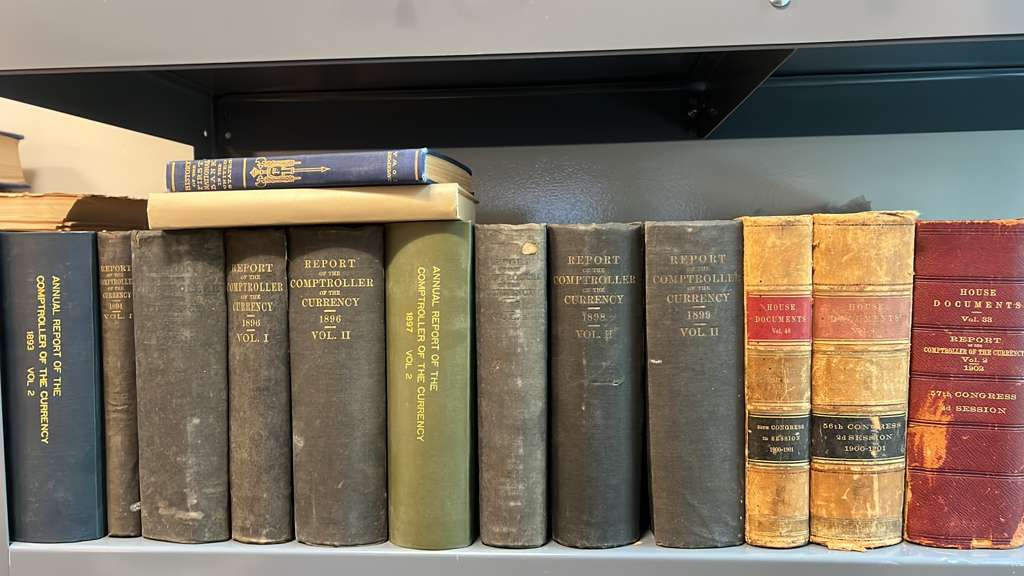
Peter Huntoon and William Raymond assembled what may be the most complete privately held set of these reports, covering 1863 through 1935 including the elusive supplements. Peter generously donated this collection to us, and it has been invaluable for improving and validating the dataset. Below is Peter's own account of how the collection came together.
Assembly of the Huntoon-Raymond Set of Comptroller of the Currency Annual Reports
By Peter Huntoon, March 2026
Tom and Eleanor Conklin met Kathy and me (Huntoon) in Andes for breakfast, and then visited Ron Guichard from whom I purchased the Andes reports. This occurred about June 1993.
The FNB of Andes, NY, set of Comptroller of the Currency Reports found by Tom Conklin started in 1868 and was complete through about the 1880s, except for 1869. Shortly after I got it, I visited William Raymond, 660 E. Carmen, Fresno, CA 93728, who had been avidly collecting the annual reports since the early 1960s. His was an eclectic assortment with diverse bindings accumulated from every source imaginable.
Our two holdings fit together hand-in-glove.
Amazingly, Raymond had pretty well filled out just about everything from about 1880 through 1940 except for the vol. 2 bank listings for 1923 through 1935. Those listings were distributed as unbound paper supplements that bankers treated like phone books and didn't save if they got them at all.
The following were missing between the two sets:
- 1863–6
- 1869
- 1917 vol. 2
- 1919 vol. 2
- 1928 vol. 1
- 1934 vol. 1
- 1935 vol. 1
- All vol. 2s from 1923 through 1935
In all, there were 23 missing items, mostly the ephemeral supplements.
Raymond owed me a few thousand dollars from an estate sale we were handling, so I took his entire Comptroller report holding as payment.
Through fantastic good fortune, the University of Wyoming had a complete set from 1867 through 1935, so before Raymond gave me his, he had photocopied all the missing supplements. I photocopied the missing 1869, 1928 vol. 1, 1934 vol. 1 and 1935 vol. 1. This left only 1863–6. I was able to photocopy those last 4, which were thin volumes as you might expect, at the Library of Congress.
I never saw any of the items I photocopied go by in the market to replace my photocopies.
As for the duplicates between Andes and Raymond, I gave them to Doug Walcutt. They went to Bob Kvederas upon Walcutt's death. That group involved maybe 6 or 8 volumes, mostly from the 1880s.
Here is what I know about other sets.
- The Library of Congress has a full set.
- The Comptroller of the Currency's office had a full set that their records management officer boxed up and sent to the National Archives several decades ago. Unfortunately, they were in purgatory status with a termination date pending a decision by the Archives whether they should be saved. The clock ran out and they were destroyed because the archives don't routinely save published Federal reports. That is the responsibility of the Library of Congress.
- The FRB of St. Louis has a virtually complete set except for the earliest volumes and maybe 3 or 4 of the others. They uploaded what they have as PDFs to the web through their FRASER website. When Andrew Pollock was transcribing the bank data, he used FRASER as his source. When Mark Drengson and I uploaded Pollock's data set to the SPMC website, we fleshed out all the info from the volumes that were missing from FRASER in order to provide complete coverage for the SPMC data base. Pollock took 3 years to create his data set. It took Mark and me a few weeks to finish the job, which was a miserable experience. I simply don't know how Pollock could stand to do the job.
- The Chase NB had a complete set beginning in the late 1860s, except for the paper bound supplements. Gene Hessler was curator of the Chase currency collection so when the bank deaccessioned it, Gene sent the notes to the Smithsonian and the C of C reports to the Higgins Museum. The Higgins Museum still has them.
These are the only sets I know of. Others surely survive in Congressional Serial sets in major libraries around the country, but Raymond and I never found them to copy the supplements or early volumes. They are rarely used, so libraries that do have them usually have moved them to "deep storage," which is exactly what happened to the University of Wyoming set after I left. In order to see them, one must submit a request well in advance so they can be retrieved.
Peter Huntoon
March 2026
For a more detailed perspective on how the Andes set was originally discovered, see Tom Conklin's article: The First National Bank of Andes (PDF).